Overview
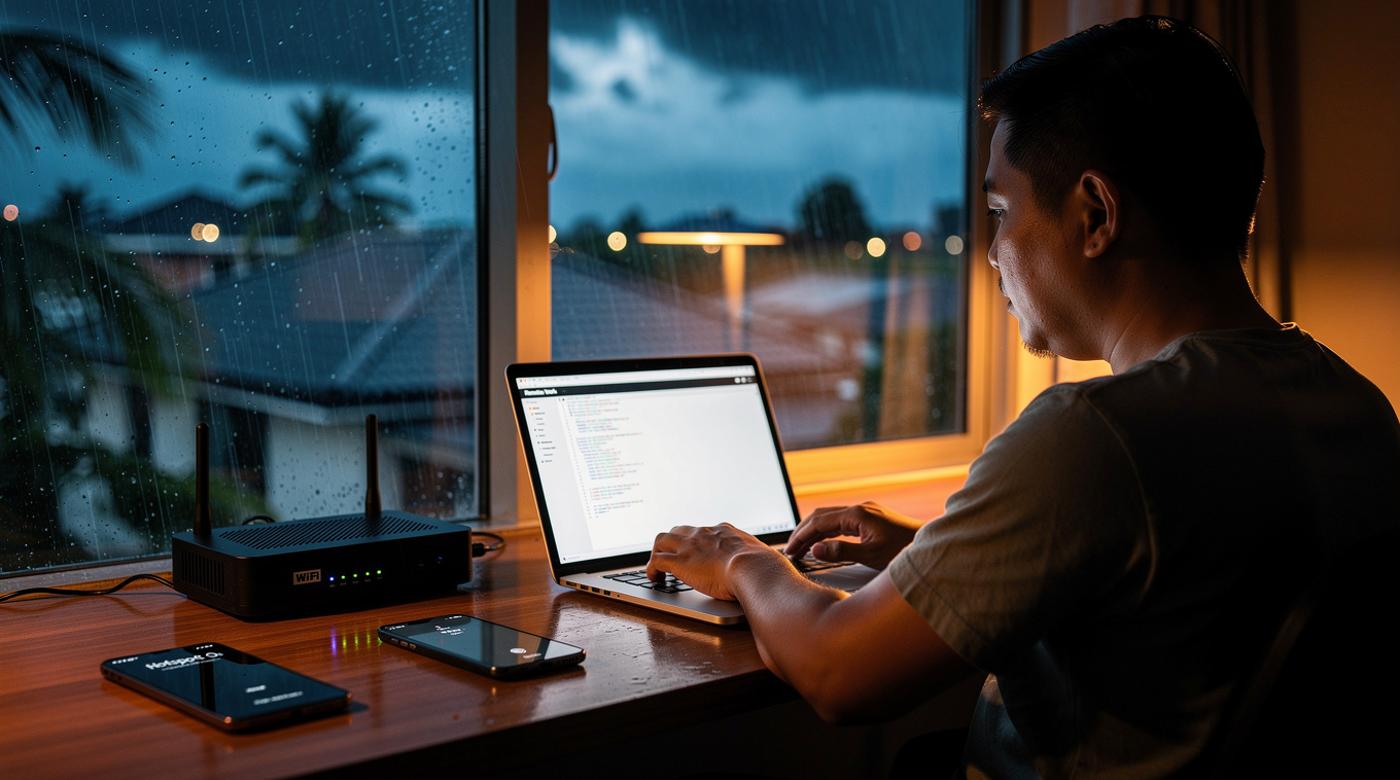
Typhoons and remote work in the Philippines are often mentioned in the same breath, usually by an employer who has just seen a storm on the news. The worry is fair. The picture behind it is more specific than the headlines suggest.
The Philippines sits in the busiest cyclone basin on earth. PAGASA says more tropical cyclones enter the Philippine Area of Responsibility (PAR) than anywhere else in the world, averaging 20 a year. But only about 8 or 9 cross the country, and each one hits a limited region. A worker in a storm's path may lose power and internet for days. A worker elsewhere may notice nothing.
That difference should shape how employers plan. This guide covers when the season runs, what outages do to a working day, what keeps work going (backup power, a second connection, coworking spaces, written handovers) and where the available evidence runs out. It ends with a checklist.
One limit up front: the research behind this article covers typhoon frequency and internet figures well. It does not cover power outage statistics, provider restoration times or BPO continuity practice, and the article does not pretend otherwise.
How Many Typhoons Hit the Philippines in a Typical Year
PAGASA's figure is an average of 20 tropical cyclones entering PAR each year, with about 8 or 9 crossing the Philippines. The 20 counts every system in the area, from tropical depressions to super typhoons, and many stay offshore or stay weak.
When the season runs
PAGASA puts the peak at July through October, when nearly 70% of typhoons develop. The edges are less tidy than the calendar suggests:
- In 2025, PAGASA forecast 11 to 19 tropical cyclones entering PAR from June to November.
- The first system of 2025 formed as early as February 11, according to Gulf News.
- PAGASA's outlook of 1 October 2025 expected up to nine more storms before year-end, including 2-4 in October and 2-3 in November.
So the season is best treated as a peak with a long tail, not a fixed window. Employers who plan only for July through October will be caught out by a late-year storm.
Years can run hotter than forecast
PAGASA's early forecast for 2025 was 16 to 19 cyclones entering PAR for the year. By 2 October, 16 had already affected the Philippines, with Paolo the latest, per the same Gulf News report. A forecast is a range, not a ceiling.
What the numbers do and do not mean
The headline of 20 storms a year overstates the risk to any single worker. Most of those systems never make landfall, and the research found no regional landfall frequency, so no one can say from these sources how often a given province is hit. The sensible reading is that risk is local and uneven. It is not a country-wide shutdown several times a year.
What Outages Actually Do to a Remote Worker's Day
The research found no outage-duration data from providers or from the Department of Energy, so this section describes mechanisms and does not quote figures.
A power cut and an internet drop are different problems with different fixes:
- Power loss takes down the router and, after a few hours, the laptop. A fiber line can be perfectly healthy and still be useless because the router is dark.
- Internet loss with power intact leaves the worker able to draft, edit or code offline, but cut off from meetings, chat and shared documents.
- Both at once is the storm scenario. It is also when a worker may be dealing with damage at home, which is a human problem before it is a productivity one.
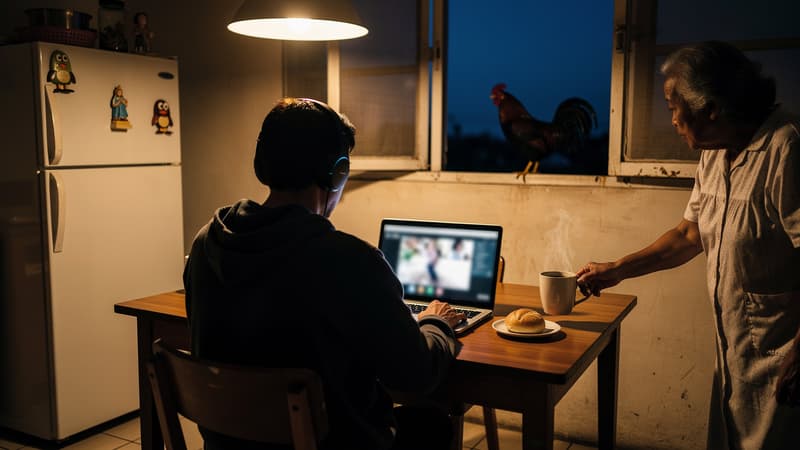
The practical consequence for a manager abroad is mostly silence. A teammate who vanishes mid-shift looks identical whether the cause is a dead router, a flooded street or something else. That is why reporting protocols matter as much as hardware.
Is Internet Speed the Problem? Mostly No
Speed is not the weak point. Ookla's median fixed download speed in Q2 2024 was 94.42 Mbps, up from 91.7 Mbps a year earlier. That is comfortable for video calls and cloud tools.
The Philippines still trails regional peers. GSMA, citing Ookla's Q2 2024 data, lists the comparison below.
| Market | Median fixed download, Q2 2024 (Mbps) |
|---|---|
| Singapore | 284.93 |
| Thailand | 231.01 |
| Vietnam | 135.00 |
| Malaysia | 132.72 |
| Philippines | 94.42 |
The table shows a real gap, but the gap is about headroom, not usability. The ranking has also been moving the right way. In February 2025 the country ranked 65th for mobile and 58th for fixed broadband. A later BusinessWorld report puts fixed broadband at 62nd of 149 markets with a median of 114.34 Mbps, still below the global median, and mobile at 71st of 102.
The takeaway: average speed is adequate. The exposure is reliability during weather and power cuts, and the research holds no provider outage data to size that risk. Treat any confident claim about it, in either direction, with caution.
Keeping Work Going: Four Layers of Resilience
Backup power
The cheapest fix protects the router first. A small UPS or power bank can keep a router alive through a short cut, and a portable power station can stretch that further. The research has no confirmed prices for UPS units, power banks, power stations or generators, so employers should get local quotes before setting a stipend. The principle holds regardless: keep the connection alive, then the laptop.
A second internet connection
A different carrier's mobile data is the simplest backup. It costs little to set up, and it fails differently from fiber because it uses different infrastructure. It also depends on cell towers having power, so it is not bulletproof after a major storm.
Where both fiber and mobile are unreliable, Starlink is the heavier option. The figures:
- Monthly price: the Residential plan rose to PHP 3,800 a month from PHP 2,700. It is unlimited and meant for fixed-location household use.
- Hardware: sources conflict. One local reseller listed the Residential kit at PHP 28,800 (out of stock), and another site gives about PHP 33,500 upfront. Reseller sites are weak sources, so employers should check Starlink's own site.
- Performance: GSMA notes Starlink performance lags fixed broadband. A satellite link is a backup, not an upgrade.
At PHP 3,800 a month, Starlink is a large add-on against a typical Philippine salary, so it likely makes sense only as an employer-funded stipend for workers in poorly served areas. For most workers a second mobile connection does the job at a fraction of the cost.
Coworking spaces and fallback locations
The research found nothing on coworking availability or how well spaces cope during storms, so no claim about their reliability can be made here. The logic is still sound: a named fallback location gives a worker somewhere to go when home is dark. The one check that matters is whether the space has its own backup power. A coworking space on the same dead grid is no fallback at all.
Handovers across time zones
When the team spans time zones, a worker's outage often lands while the manager is asleep. Written handovers shrink the damage. A shared document with status, blockers and next steps means a gap does not halt the team, and a cross-trained backup for each critical task means a missing person does not stall a deadline. Tooling helps here, and Flex's guide to tools for managing an offshore team covers the daily set. For teams working with New Zealand, the working hours breakdown shows how the overlap falls.
Real Risk vs Overstated Risk
| Concern | Verdict | Why |
|---|---|---|
| Typhoons hit 20 times a year | Overstated | 20 counts every system in PAR; about 8-9 cross land, each affecting a limited region |
| A storm will disrupt a worker in its path | Real | Local power and connectivity loss is plausible for days, though no provider data was found to size it |
| Internet is too slow | Overstated | Median fixed speed is around 94-114 Mbps depending on the report |
| Season is only July-October | Partly true | That is the peak, but storms formed as early as February and run into November and later |
| Backup connectivity is a luxury | Depends | A second mobile line is cheap; Starlink is costly |
The common thread is geography. Employers who know where each person lives can judge exposure far better than any national average allows. Candidates and workers are usually forthcoming about this if asked early, which fits naturally into onboarding.
Who Pays for Resilience
Nothing in the research settles who should fund backup gear, but the cost logic points one way. A worker earning a local salary should not be expected to buy a satellite dish. A modest stipend for a UPS and a second SIM is a small cost next to a missed deadline, and it signals the kind of care that keeps people in the job. Flex's look at why Filipino remote employees leave is a useful companion on that point.
Companies that hire through providers should ask how continuity is handled. Some staffing firms, Flex among them, vet Filipino professionals and place them with remote teams, either employing them directly or letting clients hire them. How a provider handles an outage is worth asking before signing, whichever model is chosen.
Employer Checklist
- Ask each worker for their province and typhoon exposure. Peak risk is July-October, but storms can fall outside that window.
- Require a second connection: a different carrier's mobile data, or a stipend toward Starlink where fiber and mobile are both unreliable.
- Fund backup power for the router and laptop, such as a UPS, power bank or small power station.
- Name a coworking space or fallback location for each worker, and confirm it has its own backup power.
- Set an outage protocol: how to report an outage, who to notify, and a maximum silent window before escalation.
- Write handovers in a shared document with status, blockers and next steps.
- Cross-train a backup person for each critical task.
- Offer flexible deadlines or paid leave for workers hit by a major storm.
- Test the plan before the season, for example by cutting power and fiber and measuring the time to recover.
Conclusion
The risk is real but narrower than the headline number implies. About 8 or 9 storms a year cross the Philippines, peak season runs July through October, and the season can start early and finish late. A worker's exposure depends on where they live far more than on the national average.
Speed is not the issue; reliability during storms and power cuts is. The fixes are modest: protect the router, add a second connection, name a fallback location, write clear handovers and agree on how silence gets escalated.
The gaps matter too. This article could not size outage durations, provider restoration times or backup costs, and employers should gather local figures before committing a budget. Teams that plan before the season, and test the plan, will find that a typhoon becomes a scheduling problem and not a crisis.