Overview
On October 27, 2026, the Philippine peso closed at P64.17 to the dollar, its 33rd record low of the year, according to GMA News. Ten months earlier, on January 7, the first record low of 2026 stood at P59.355. That is a steady, grinding descent, and it has split Filipino workers into two very different experiences.
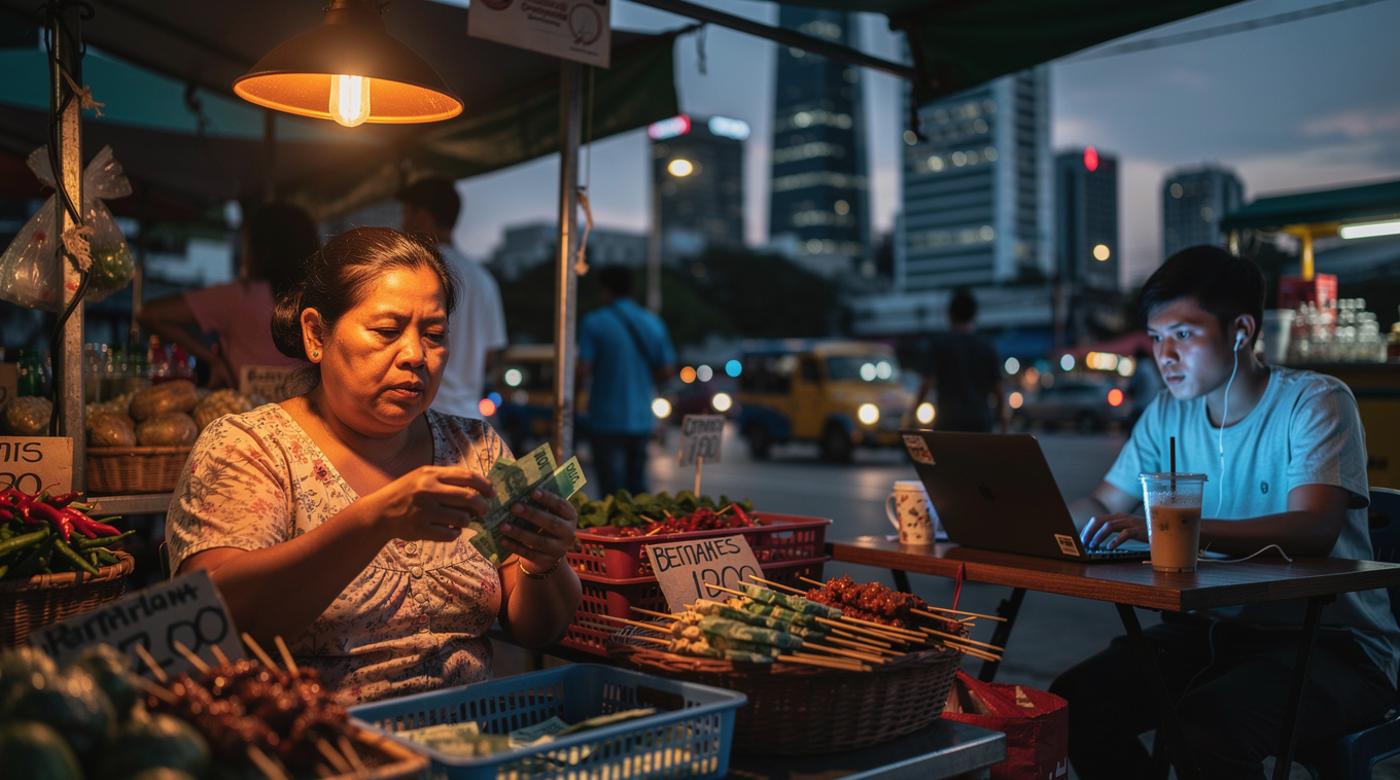
On one side are locally employed workers paid in pesos. Their salaries buy less each month as prices climb. On the other are remote workers, freelancers and others paid in US dollars, whose income converts into more pesos with every new low. The same exchange rate that squeezes one household quietly pads another.
Is the peso "dying"? The sources do not say so. One economist described the slide as "largely a reflection of a stronger US dollar rather than a sign of economic weakness in the Philippines." Others point to domestic causes, including twin deficits and elevated inflation. The picture is messier than a collapse, and so is the verdict on who wins. This article lays out the numbers, the good, the bad, and the places where the popular narrative runs ahead of the evidence.
How the Philippine Peso Got to P64
The slide did not happen overnight. It built through the year, with a few sharp steps.
| Date (2026) | Peso per US dollar | What happened |
|---|---|---|
| January 7 | P59.355 | First record low of the year |
| March | P60 | Slide begins in earnest, tied to the Middle East war and oil |
| April | Above P61 | Peso breaks past P61, per Rappler |
| August 28 | P62.265 | First close past P62 |
| October 19 | P63.09 | 28th record low of the year |
| October 27 | P64.17 | 33rd record low |
| Early November | About P63 | Rebound after breaching P64 the previous week |
The table shows a pattern: each psychological level fell faster than the last. The administration's own budget assumption was a range of 60 to 62 per dollar for the year, and the peso has traded well beyond it, as the Inquirer reported.
What pushed it down
Two explanations compete, and both have evidence behind them.
The first is external. Economists tie the March drop to the Middle East war and oil prices. One cited a peso that had weakened by more than 6% since the war on Iran began on February 28, 2026. A strong US dollar did much of the rest.
The second is domestic. Robeco's Philip McNicholas pointed to large twin fiscal and current-account deficits and elevated inflation, as Al Jazeera reported. Trading Economics also cited a deteriorating current-account balance and declining investor confidence amid a government corruption scandal.
The central bank tried to lean against the move. The BSP called a rate hike a preemptive response to emerging inflation risks, but the hike did little to bolster the peso. President Marcos urged the public not to panic, saying the administration had "all the tools to defend the peso."
As for what comes next, economist Victor Abola expects the peso to weaken further to P66 per dollar next year, per BusinessMirror. That is a forecast, not a certainty, and the early-November rebound to around P63 shows how quickly sentiment can swing.
The Bad Side: Peso Earners Pay Twice
For a worker paid in pesos by a local employer, a weak currency is not an abstraction. It shows up at the grocery store, the gas pump and the electricity bill.
Inflation does the damage
Headline inflation hit 7.2% in September, up from 6.1% in August, according to PSA data reported by Rappler. Average inflation from January to September was 5.4%, well above the government's 2-4% target. Trading Economics lists October at 7.80%, though that figure comes from an aggregator and has not been confirmed against a PSA release, so it should be treated as provisional.
The drivers cited include bad weather lifting food prices, higher fuel costs and the weaker peso itself. The mechanism is straightforward: importers must convert more pesos to buy dollar-priced crude, and that cost flows downstream into transport, goods and utilities. An RCBC economist put the broader point bluntly, saying a weaker peso would fundamentally erode the peso's purchasing power.
A fair caveat belongs here. The peso is not the only culprit. Food and weather also pushed prices up, so it would be wrong to pin all of the inflation on the exchange rate.
Wages are chasing prices
Minimum wages did rise. Under Wage Order NCR-28, Metro Manila's minimum is reported at P755 a day for most workers from September 26, 2026, and P718 for some smaller employers, according to a secondary guide to Philippine minimum wages. Those figures come from secondary sources rather than the wage board itself.
The more striking number comes from BusinessWorld. It reported that inflation-adjusted wages were 24.8% to 30.9% lower than current daily minimum wages across regions in September, a gap of roughly P116.35 to P187.33 in peso terms (BusinessWorld). That is arguably the clearest single illustration of the squeeze. Two cautions apply. The comparison appears to measure real wages against the nominal minimum, and the base period is not stated, so the percentage should be read as indicative rather than precise. And because NCR-28 took effect on September 26, the September data may not yet reflect it.
Savings, debt and rates
The Manila Times warned that peso weakness is especially dangerous for anyone with dollar-denominated expenses or debt. Anyone holding peso savings sees their real value shrink as prices rise. Rappler lists rising costs of living and potentially higher interest rates as the reasons the overall impact on households is negative.
There is a subtler effect too. The same Manila Times column suggests peso earners may retreat from economic activity, while dollar earners are well positioned to fill any void and to buy assets that peso earners are selling. It is an uncomfortable idea: a currency slide can quietly move ownership from one group to another.
The Good Side: Why Dollar Earners Are Ramping
Now flip the view. Someone paid in US dollars sees the opposite arithmetic.
The conversion bump
GMA reported that a weaker peso benefits freelancers, export-oriented firms and BPO companies, who are mostly paid in dollars (GMA). An RCBC economist quoted in the same piece named OFWs and their families, exporters, BPOs, foreign tourists and foreign investors as beneficiaries. The Manila Times put it in purchasing-power terms: the greenbacks an OFW, exporter or freelancer holds can significantly increase their purchasing power relative to peso earners.
A simple illustration helps. A hiring-agency blog calculated that $1,000 a month converted to P59,440 rather than P55,000 under older rates. At today's roughly P64, the same $1,000 is about P64,000 (this last figure is simple arithmetic, not a sourced quote). The worker did nothing differently. The exchange rate did the work, which is why one crypto-focused blog described it as an instant salary bump without having to ask for a raise. That source has an angle, so the claim is best read as a description of the arithmetic, not as a finding.
Not a windfall
Here the narrative needs restraint. Dollar earners still buy groceries, fuel and electricity in the Philippines. They face the same inflation of 7.2% or more. If a dollar earner's peso income has risen by something like 9% since the start of the year (a rough calculation from a secondary source's starting rate, not a verified figure), and prices are rising at 7-8%, the real gain is small. The advantage is relative to peso earners, not absolute.
There is also reversal risk. A hiring-agency analysis warned that if the peso strengthens, the local purchasing power of dollar earners drops. The boost lasts only as long as the weakness does.
One more honest note: no hard 2026 data on the number or income of Filipino remote workers and freelancers turned up in the research. The case that they are "ramping" rests on exchange-rate arithmetic and expert comments, not on a measured income survey.
Remote work as a practical route
For workers weighing a move from local employment to dollar-paid remote work, the arithmetic above is the draw. Talent companies such as Flex vet Filipino professionals, from virtual assistants and marketers to editors, developers and designers, and place them with remote teams worldwide. Whether a given role pays in dollars, and on what terms, depends on the arrangement, so workers should check how pay is denominated before assuming a currency gain.
The BPO Question: Who Captures the Gain?
The business process outsourcing sector sits at the center of this debate, and it cuts both ways.
BPO contracts are billed in US dollars while payroll is in pesos. A weaker peso therefore lifts revenue in peso terms without lifting costs, and the margin goes to the employer. One employer-side opinion piece argued that a weak peso lets BPO firms hire at lower dollar cost, making the Philippines more competitive as an outsourcing destination.
Whether that margin reaches workers is another matter. Peso-paid staff do not automatically receive a bump from the exchange rate. That point is an inference rather than a sourced finding, so it is best framed as a question to ask: only workers paid directly in dollars, or with raises tied to the rate, clearly capture the gain.
The industry itself is cautious. The BPO lobby IBPAP warned that rising inflation and wage pressures could soon erode the financial gains from the weaker peso, as Nearshore Americas reported. In other words, the exchange-rate cushion is real but may be short-lived, because the same inflation that hurts workers pushes wage demands upward.
OFWs and Remittances: A Currency Illusion?
Overseas Filipino workers are the classic dollar earners, and their remittances show how tricky the picture is.
BSP data show cash remittances rose 2.2% to $23.424 billion in January-August 2026. In dollar terms, that is slow. May's 2% growth was the slowest in four years, according to BusinessMirror. Cited drivers include the Middle East conflict weighing on deployment, higher living costs in host countries, base effects and inflation back home.
In peso terms, the story changes. Pantheon Macroeconomics said annual remittance growth in peso terms accelerated to a double-digit pace from below 3% in February (BusinessWorld). But Pantheon added a caveat: red-hot inflation has prevented the peso surge in inflows from translating into stronger domestic consumption, a pattern it compared to 2022.
The lesson is that more pesos arriving is not the same as more goods bought. Families receiving remittances gain on paper, then hand part of it back to higher prices.
Economists Disagree: Net Positive, Net Negative or Mixed?
The experts do not speak with one voice, and the disagreement is instructive.
- Net positive: Abola of the University of Asia and the Pacific argues depreciation is positive because around 70 million people benefit from it. He repeated that view on November 5, 2026.
- Net negative or an illusion: The Philippine Institute for Development Studies (PIDS) warned that the benefit is largely an illusion once imported inflation is factored in. One crypto-focused blog also calls a rapidly depreciating peso a net negative.
- Mixed: UnionBank's Asuncion called it a "mixed blessing," saying the net gain depends on whether exchange-rate gains outpace rising living costs. PIDS's John Paolo Rivera said the benefit holds in the short term, but imported inflation erodes purchasing power in the medium to long run.
The common thread is timing. A weak peso helps dollar earners first and hurts everyone through prices later. Economists broadly agree that neither a persistently weak nor an overly strong peso is ideal.
Who Wins and Who Loses: A Side-by-Side View
| Group | Income currency | Effect of a weak peso | Main risk |
|---|---|---|---|
| Local employees on peso salaries | PHP | Prices rise faster than pay; purchasing power erodes | Inflation at 7%+ and slow wage catch-up |
| Remote workers and freelancers paid in USD | USD | More pesos per dollar earned | Reversal if the peso strengthens; same local inflation |
| BPO employers | USD revenue, PHP payroll | Wider margins | Wage pressure erodes the gain |
| Peso-paid BPO staff | PHP | No automatic bump (inference) | Same cost-of-living squeeze |
| OFW families | USD sent home | Double-digit peso remittance growth | Inflation blunts consumption gains |
The table makes the central point visible: the exchange rate itself is neutral. What matters is the currency in which a person is paid and the currency in which they spend. Those who earn in dollars and spend in pesos hold a structural advantage while the peso falls. Those who earn and spend in pesos hold none.
What Workers and Households Can Reasonably Do
The research describes the problem far better than it prescribes solutions, so any advice should stay modest and tied to the evidence.
- Check the currency of your pay. The gain accrues only to income denominated in dollars or tied to them. A job at a dollar-billing company is not the same as a dollar salary.
- Watch real wages, not nominal ones. A raise below the inflation rate is a pay cut in practice. With inflation reported at 7.2% in September, even a decent-looking increase can fall short.
- Be careful with dollar debt. The Manila Times flagged dollar-denominated expenses and debt as especially risky when the peso weakens.
- Do not assume the trend continues. The peso rebounded to around P63 in early November after breaching P64. Forecasts such as Abola's P66 are views, not guarantees, and a stronger peso would shrink the dollar earner's edge.
Where the Evidence Runs Thin
A few honest gaps deserve a mention. The research found no 2026 data on how many Filipinos work remotely for dollars or how much they earn, so the size of the "ramping" group is unknown. The inflation-adjusted wage gap reported by BusinessWorld has an unstated base period. Some figures, such as the October inflation reading and several minimum-wage details, come from aggregators or secondary sources rather than the PSA or the wage board. And the peso's path depends on oil, the US dollar and domestic politics, none of which can be forecast with confidence.
These gaps do not overturn the core finding. They simply mean the debate should be argued with numbers where numbers exist and with caution where they do not.
Conclusion
The peso is not dying, but it is weakening in a way that sorts Filipino workers into winners and losers. Peso-paid employees absorb inflation of 7.2% in September while real wages lag. Dollar earners, from freelancers to remote professionals to OFW families, convert income at P64 instead of P59, and gain relative standing, though not a windfall, because they shop in the same expensive economy.
The key takeaways are simple. The slide reflects both a strong US dollar and domestic weaknesses. The benefit to dollar earners is real but eroded by the same inflation that hurts everyone else. Employers, especially in BPO, capture exchange-rate margins that do not automatically reach workers. And economists agree that neither an overly weak nor an overly strong peso serves the country well.
Looking ahead, the direction depends on oil prices, the strength of the dollar and whether the Philippines can narrow its deficits and restore investor confidence. If Abola's P66 forecast proves right, the divide between peso earners and dollar earners will widen further. If the peso recovers, the dollar earner's advantage will narrow. Either way, the currency in which a person is paid has become one of the most consequential facts about their finances.