Overview
Most articles about Filipino work culture for US managers are folklore: essays about shame, resilience and smiling through hardship that read like a textbook from 1970 and help nobody run a Tuesday standup. A Filipino teammate does not need translating; they need a manager who knows a handful of concrete facts about the calendar, the law and the communication patterns, and adjusts the ordinary machinery of management around them.
This article is those facts. Six specifics, each with the operational consequence attached, and nothing about national character.
The calendar runs differently, and December is the big one
The Philippine holiday calendar is dense: regular holidays and special non-working days together typically put eighteen or more dates on the year, with clusters at Holy Week and the year's end. A US manager who plans sprints against only the US calendar will hit them by surprise; the fix is one shared calendar, loaded once a year.
The season that matters most is long. Christmas in the Philippines starts when the ber months do; decorations and countdowns appearing in September is normal, and the last two weeks of December are family weeks in a way US Thanksgiving only gestures at. Meanwhile the law adds a real financial rhythm: 13th month pay, a mandatory extra month of salary paid by December 24. The operational consequences are simple. Do not schedule a major launch for the third week of December. Know that the 13th month is a legal floor, not a bonus, so a genuine performance bonus should be named as its own thing. And expect December conversations about money to be planning conversations; the extra month is usually spoken for before it arrives.
Family is the reason they are on the call
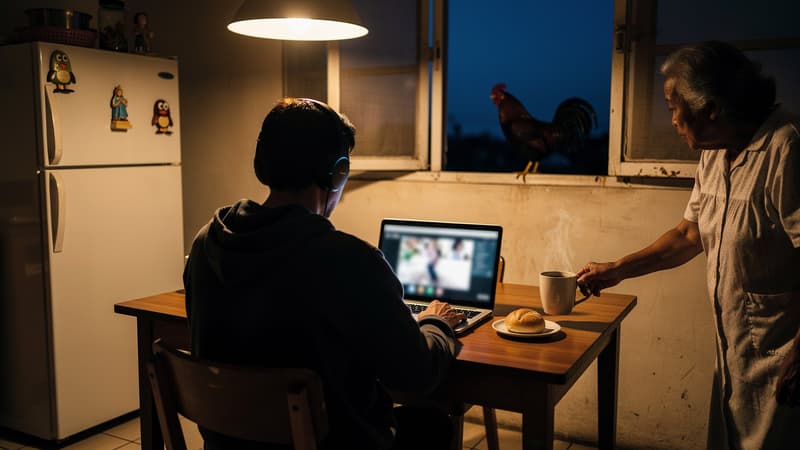
The single most useful reframe: for a large share of Filipino remote workers, remote work is not a lifestyle preference, it is the technology that lets someone with world-class skills stay in the same house as their parents and children instead of working abroad or moving to a Manila tower. The supply of excellent people in the provinces exists precisely because they chose home.
That choice has management consequences. Family events carry the weight US managers assign to medical events; a grandmother's funeral is not negotiable and asking someone to trade it for a deadline spends loyalty that will not come back. Benefits land differently: health coverage that includes dependents is often valued above a raise of the same cost. And the flip side is real too: a teammate whose family depends on the role tends to protect it with a seriousness that shows up in retention, if the employer holds up its end.
The communication pattern, and what actually fixes it
The pattern US managers actually meet is not shyness; it is a default against contradicting someone senior in an open channel. An unclear instruction is more likely to produce a careful guess than a clarifying question, and "yes" in a meeting sometimes means "I heard you" rather than "I agree and can do this by Friday".
Folklore stops there; management does not. The fix is structural, not motivational. Make questions a required deliverable: end briefs with "reply with your top two questions before starting", which turns asking from a status risk into compliance. Ask for stated assumptions instead of confidence: "tell me what you assumed" surfaces the guess before it ships. Move disagreement to private, written channels where deference costs less. Teams that do this report the pattern fading within months, because it was never a capability problem; it was a cost-of-speaking problem, and the manager sets that price. Skills assessments in this market show the same thing from the other end: the sharpest separator among otherwise similar candidates is what they do when instructions run out, ask, state an assumption, or bluff, which is exactly the behaviour a manager's structure either rewards or punishes.
The weather is an operations fact
The Philippines takes around twenty tropical cyclones into its area of responsibility in an ordinary year, and the habagat monsoon floods cities on no particular schedule. Class suspensions reorganize a parent's day with a morning's notice; power and fiber can drop in a storm and stay down for days in a bad one.
None of this is a reliability verdict on the person; it is a planning input for the manager. The standard kit is boring and works: agreed expectations about a backup connection or a nearby co-working fallback, a personal-hotspot allowance, a no-drama protocol for storm days (asynchronous handover notes instead of hero attendance), and documentation habits that let a teammate drop for four hours without the work dropping with them.
Night shift is normal here, and it still has a cost
Working US hours from the Philippines is socially normal at a scale Americans underestimate; an entire national industry runs overnight, and candidates will say yes to a US-hours schedule readily. The law prices it anyway: a mandatory night shift differential of at least ten percent for work between 10pm and 6am. A US manager should treat the premium as the honest cost of the overlap rather than a fee to negotiate away, and remember what it buys is finite: a permanent graveyard schedule is sustainable for some people and quietly corrosive for others, so the better designs bias the overlap, three or four shared hours, rather than a full US day forced onto Manila midnight.
What not to import
Two US habits travel badly. At-will instincts: Philippine employment law has no at-will; regularization, due process and separation rules are covered elsewhere at length, but the cultural point is that job security is part of the deal being made, and managing as if it were not reads as bad faith. And surveillance-heavy management: screen-recorders and keystroke counters read as distrust everywhere, but in a market where the person chose this arrangement to be trusted with their own house and hours, they cost more than they measure. Companies that want the structure without inventing it, the calendar, the differential math, the check-in cadence, can start from a role brief with those defaults already in place.
Conclusion
Filipino work culture for US managers comes down to a short list of concrete facts, not a psychology course: a dense holiday calendar with a long December, a legally mandated 13th month, family as the reason the arrangement exists, a communication default the manager's own structure can reprice, weather as a planning input, and a night shift that is normal but never free. A manager who loads the calendar, budgets the differential, writes questions into every brief and keeps December honest will find that most of what the folklore essays call cultural difference was just management debt with an accent.