Overview
The first question most American businesses ask about hiring in the Philippines is not about cost or skill. It is about the clock. Manila sits 12 to 16 hours ahead of the United States, and the spread depends on two things the buyer rarely has in front of them at once: which US time zone the team works in, and whether the country is on daylight saving time.
The short version is that a Filipino employee working a standard US business day works through the Philippine night, and the Philippines has a law about that. The longer version is a table, a few rules about pay, and a choice between three staffing patterns that each answer the clock differently. All three are in use; none of them is free.
What follows is the arithmetic, stated once so it stops being guessed.
The offset, by zone and by season
The Philippines keeps one time zone for the whole country, UTC+8, and has not observed daylight saving time since 1990. Manila, Cebu and Davao read the same clock all year. The United States, for most of its territory, moves the clock forward one hour on the second Sunday of March and back on the first Sunday of November. In 2026 that is March 8 and November 1.
That single fact produces the whole table. Because Manila never moves and the US does, the gap shrinks by one hour in the American summer and grows by one hour in the American winter.
| US zone | Mar 8 to Nov 1 (daylight time) | Nov 1 to Mar 8 (standard time) |
|---|---|---|
| Eastern | Manila is 12 hours ahead | 13 hours ahead |
| Central | 13 hours ahead | 14 hours ahead |
| Mountain | 14 hours ahead | 15 hours ahead |
| Pacific | 15 hours ahead | 16 hours ahead |
Arizona and Hawaii do not observe daylight saving time, so their gap to Manila is fixed all year: 15 hours for Arizona, 18 for Hawaii.
What a 9-to-5 US day looks like in Manila
The table above becomes concrete when a US working day is translated into Manila time. The rows below assume a 9:00 AM to 5:00 PM day in the US city.
| US zone | Manila hours in US summer | Manila hours in US winter |
|---|---|---|
| Eastern | 9:00 PM to 5:00 AM | 10:00 PM to 6:00 AM |
| Central | 10:00 PM to 6:00 AM | 11:00 PM to 7:00 AM |
| Mountain | 11:00 PM to 7:00 AM | 12:00 AM to 8:00 AM |
| Pacific | 12:00 AM to 8:00 AM | 1:00 AM to 9:00 AM |
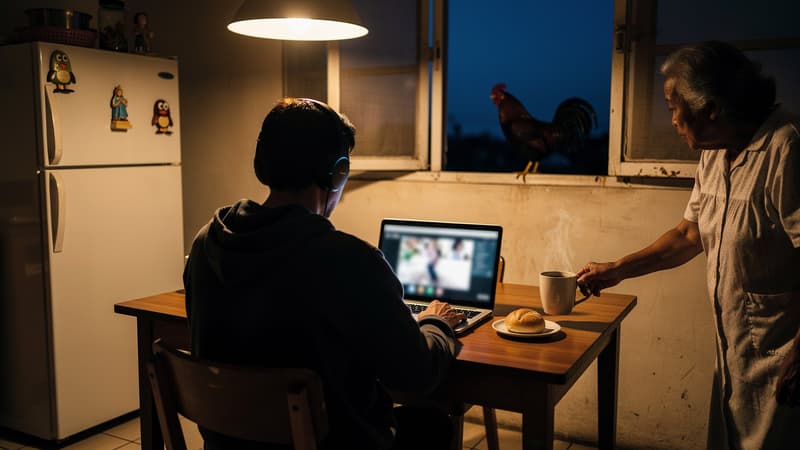
Read the right-hand columns as the employee reads them. An East Coast team's day is a Manila night shift that ends around sunrise. A West Coast team's day starts at Manila midnight and ends at breakfast. Every one of these schedules is common in the Philippine outsourcing industry, which has run on US hours for two decades; the point is not that it is unusual but that it is a night shift, and it should be named as one.
The night differential: the rule the buyer should know
Philippine labor law treats work between 10:00 PM and 6:00 AM as night work. Article 86 of the Labor Code entitles a covered employee to a night shift differential of not less than 10 percent of the regular hourly wage for every hour worked inside that window. Managerial staff and a few other categories are excluded, but the rank-and-file roles a US business typically hires from the Philippines, support, administration, bookkeeping, sales development, are covered.
Look back at the second table. For an Eastern team in summer, seven of the eight hours fall inside the 10 PM to 6 AM window. For a Pacific team in winter, five do. The differential is small per hour and it is not optional, which is why a properly run employer prices a US-hours role a little above a Manila-hours role from the start, rather than discovering it later.
Three practical consequences follow. First, a quoted salary for a "US hours" role should already include the differential; a quote that does not is a quote that will move. Second, overtime inside the night window stacks with the differential, so a late-running US day costs more than a late-running Manila day. Third, any provider that cannot say how it handles the night differential is either not the employer or not paying it.
Three ways businesses actually staff the overlap
The clock does not change, so the choice is about how much of the US day the Filipino hire is expected to cover live.
Full overlap. The hire works the complete US business day on a permanent night schedule. This is the default in customer support, inside sales and anything with a live queue. It is the pattern the Philippine workforce is most used to, and it is the one where the night differential applies in full. Retention depends on the schedule being fixed; a rotating night shift is what burns people out, not a steady one.
Partial overlap. The hire keeps a Manila-morning or Manila-evening shift that catches two to four hours of the US day at one end. A 6:00 AM to 3:00 PM Manila shift, for example, overlaps a Pacific team's afternoon in the US summer and an Eastern team's late evening. This suits bookkeeping, content, research and most administrative work, where the live window is for handoffs and questions rather than for the work itself. Fewer night hours, a lower premium, and a hire who sleeps at night.
Asynchronous with a handoff window. The hire works Manila daytime, and the two sides meet for thirty to sixty minutes at the seam, usually the US late afternoon or early morning. Development, design, reporting and anything with a queue of defined tasks runs well this way. The hidden cost is discipline on the US side: the task queue has to be written down before the US day ends, or the Manila day starts with nothing to do.
Most businesses that hire more than one person end up mixing patterns: one full-overlap seat for anything customer-facing, the rest partial or asynchronous. The mistake is hiring every seat on full overlap because the clock seemed to demand it.
Stating the hours before the hire, not after
The single most useful thing a buyer can do is write the schedule into the job description in Manila time, window and all, before a single applicant is contacted. "US Eastern business hours" is a phrase; "10:00 PM to 6:00 AM Manila, Monday to Friday, fixed" is a schedule an applicant can say yes or no to.
This is also the test of a staffing provider. A provider that shortlists people who already work the required hours, rather than people who agree to try them, removes the most common reason a Philippine placement fails in its first quarter. Flex, which employs its placements in the Philippines and runs them on the client's stated hours, only puts forward applicants who already keep the schedule in the brief; overnight and weekend coverage is treated as ordinary, not exceptional, and the hours are in the job description from the start for anyone hiring through Flex.
The other side of the same rule: a business that wants Manila-daytime work should say so just as plainly. A large share of Filipino applicants would prefer it, and the salary is lower without the differential.
Conclusion
The Philippines is 12 hours ahead of the US East Coast in the American summer and 16 hours ahead of the West Coast in the American winter, with every combination in between. A full US business day is a Manila night shift, Philippine law pays a premium for hours between 10 PM and 6 AM, and the premium belongs in the quote from day one.
The clock is fixed. What the buyer controls is how much of the US day actually needs live coverage, and how clearly the schedule is written before the search begins. Businesses that decide those two things first tend to find that the time difference is the most predictable part of the whole arrangement.