Overview
Somewhere in most remote-hiring stories there is a moment where a resume, an interview and a scanned ID all agreed with each other, and the person who started work was still not the person who was hired. The file was real; it belonged to someone else. The interview was real; a cousin sat it. The ID was real; it was photographed off a table.
Identity and background checks exist for that moment, and for remote employees in the Philippines they are cheaper and faster than most foreign employers assume. What they are not is a single thing. An identity check answers "is this the person on the document, and is the document genuine". A background check answers "is what this person claims about their past true". They use different tools, they cost different amounts, they sit at different points in the hiring process, and Philippine law has something specific to say about the consent behind both.
This article lays out each check, what it actually catches, what it cannot, and the order that keeps the cost proportionate.
An identity check is three tests, not one
A scanned ID sent over email is the weakest form of identity evidence there is. It proves that a file exists. A working identity check for a remote hire does three things, in this order.
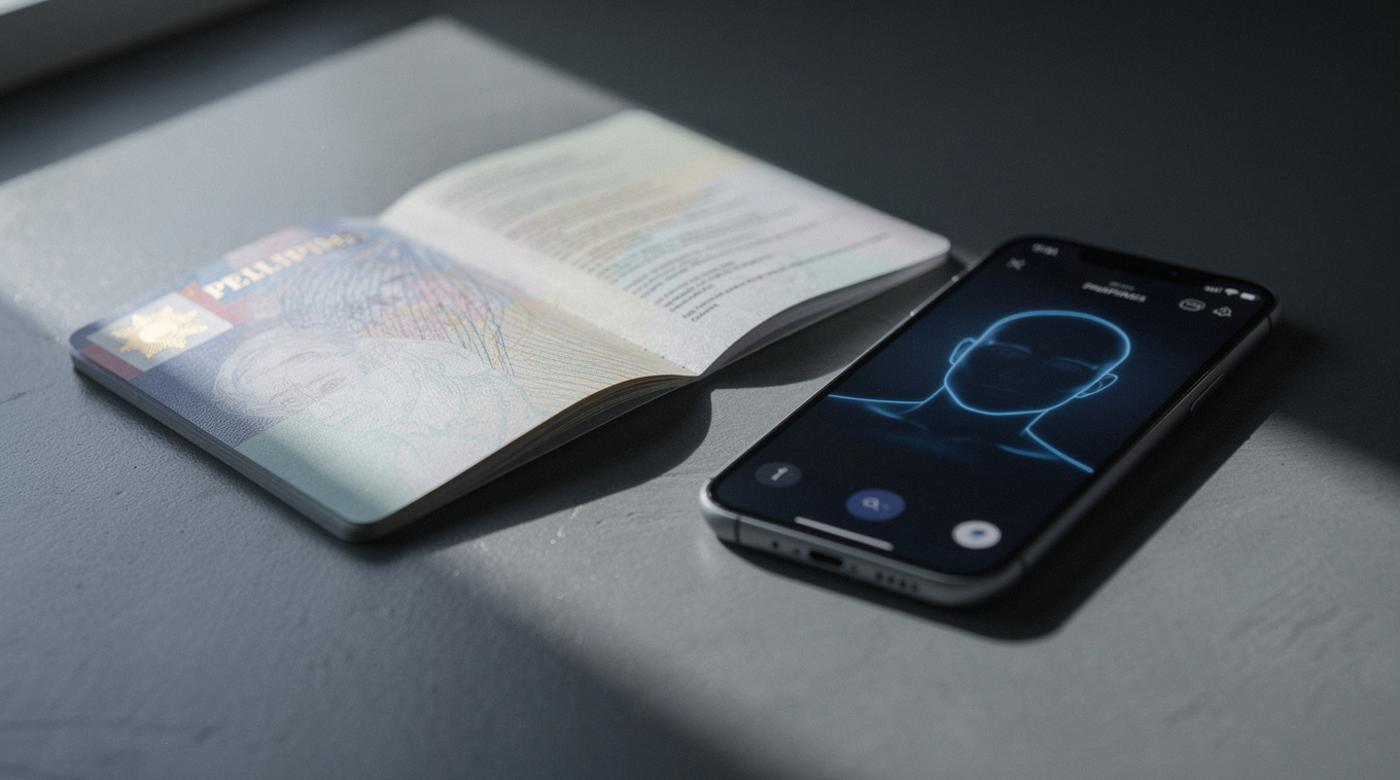
It examines the document itself. Modern verification services read the machine-readable zone, check security features, and look for the signs of editing or reprinting that a human looking at a JPEG cannot see. Forged PhilSys cards, tampered TIN IDs and printed replicas are a known problem in Philippine digital onboarding, and document authentication is the layer built to catch them.
It matches a live face to the document photo. The candidate holds up their own face to their own camera, and the service compares it with the portrait on the ID. This is the step that closes the "cousin sat the interview" hole, because the face on the document is the face that must appear on the call.
It checks that the face is live. Liveness detection confirms that the selfie is a present person and not a photograph, a pre-recorded video, or a mask. Without it, the face match can be passed by pointing a camera at a printed picture.
Together these take a few minutes for the candidate and turn around in the same session. The result is a match or a set of named reasons why not: expired document, portrait not detected, face mismatch. Some verification services also record an approximate location from the session, which is useful when the hire is expected to work from a particular country.
What a background check means in the Philippines
The identity check confirms who someone is. A background check confirms what they have said about themselves. In the Philippines the common checks are these.
The NBI Clearance is the country's principal criminal-clearance document, issued by the National Bureau of Investigation. It is the standard "no criminal record" evidence, applied for by the candidate online with a booked appointment and biometrics at a clearance centre, and widely accepted by Philippine employers as a condition of an offer. The candidate has to obtain it in person; a third party cannot pull it on their behalf, and a court-record search is not the same document and should not be presented as one.
Employment verification is widely practised and is usually a direct contact with the previous employer's HR to confirm dates and title. Turnaround runs from a few days to two weeks depending on how responsive the previous employer is.
Education verification is common but institution-dependent; some universities answer in days, others take weeks.
Professional licence checks matter for licensed professions (nursing, accounting, engineering) and can be confirmed against the Professional Regulation Commission's records in a few days.
Credit checks are role-dependent and rare outside finance.
For a remote administrative, marketing or support hire, the realistic set is identity plus NBI plus employment verification. Education and licence checks are added when the role turns on them.
The consent the law requires
The Philippine Data Privacy Act of 2012 governs all of this, and its rule for hiring is simple to state: the candidate's written consent must be obtained before any personal information is collected for a background check. Not implied, not buried in a job-application checkbox. The consent must say what will be checked, why, what data will be collected, whether it will leave the country, and how long it will be kept.
Identity verification raises the bar further, because a government ID and a face image are sensitive personal information. The National Privacy Commission does not accept "legitimate interest" as a basis for processing sensitive data; consent is the basis, and the consent has to be freely given, which means no incentive attached to it and no penalty for declining beyond not proceeding. The verification provider's name, the fact that data crosses a border, and a concrete retention period are expected in the notice the candidate sees.
There is one more rule that foreign employers often miss. A failed automated check must not end a candidacy by itself. A human with authority reviews it, and the candidate has a way to contest. Filipino applicants with common surnames, a bad phone camera, or an ID photo from years ago will fail automated checks for reasons that have nothing to do with fraud.
Employers who run checks directly are the data controller and carry the exposure. Employers who hire through a Philippine provider should expect that provider to have the consent form, the privacy notice and the retention policy written down, and should ask to see them.
When to run each check
Order is the difference between a proportionate process and an intrusive one. Asking a stranger for a government ID before showing any interest costs applicants, and it costs the employer money on people who were never going to be hired.
The practical sequence is to verify the file first (dates, employers, whether the claimed skills are described consistently), then test the skill, then interview, and only then run identity verification on the person who is about to be shortlisted. The NBI clearance and reference contacts belong at the offer stage, where the candidate has a reason to go and get them and the employer has a reason to pay for the calls.
This is the shape a staffing provider's process should take too, and it is a fair thing to ask any provider to describe in order. Flex, for instance, runs identity verification only after an applicant has passed the role assessment and before any interview is booked, so the check is spent on candidates, not on every form submission; a client meets a shortlist whose members have already been through it, and can read how the pipeline is sequenced before sending a brief.
What the checks cannot do
Honesty about the limits prevents false confidence. An identity check proves the person is who the document says. It does not prove they will do the work themselves after month one; only management does that. An NBI clearance proves no recorded criminal case in the Philippines; it says nothing about conduct abroad or about civil disputes. Employment verification proves dates and titles; previous employers in the Philippines rarely volunteer performance detail, and asking for it is where reference checks turn into hearsay.
Two habits cover most of the remaining gap. Keep the camera on for the first weeks of work, not as surveillance but as continuity: the face that verified is the face that turns up. And keep the work visible through a real ticket or task system, so that a change in who is doing it shows up in the output before it shows up in a crisis.
Conclusion
An identity check for a remote employee is a document check, a face match and a liveness test, done live, in minutes. A background check in the Philippines is an NBI clearance the candidate obtains themselves, plus employment verification and whichever of education, licence or credit the role actually needs. Both need the candidate's explicit written consent under the Data Privacy Act, and any automated failure needs a human on the other side of it.
Run them in order, late enough to be proportionate and early enough to matter: file, skill, interview, identity, then clearance at the offer. The employer who does that will occasionally lose an afternoon to a bad camera. The one who skips it will eventually lose a lot more to a face that never matched anything.