Overview
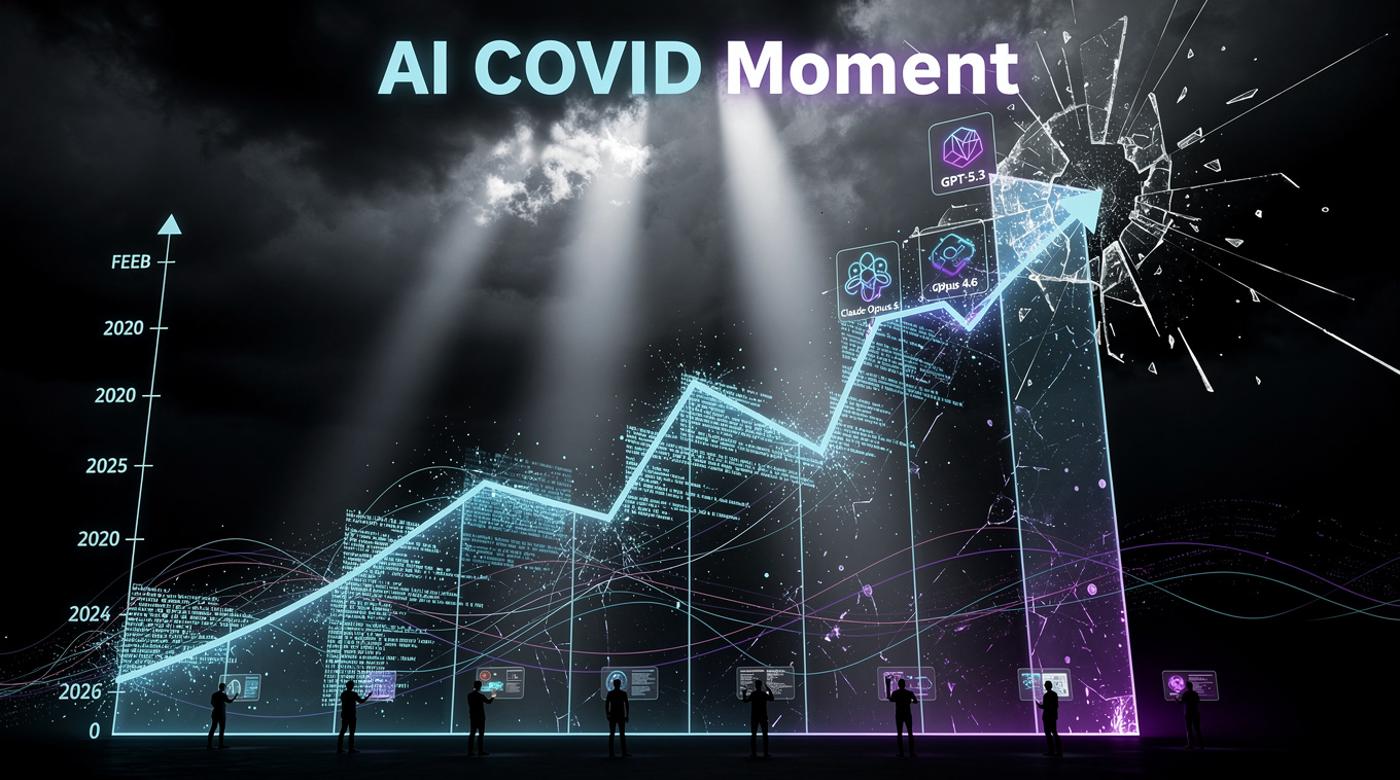
Artificial intelligence has reached a pivotal "COVID moment," akin to February 2020 when early pandemic signals seemed exaggerated before global disruption unfolded. fortune.com Matt Shumer, CEO of HyperWrite, captured this in his viral article "Something Big is Happening," arguing that AI's current phase of dismissal precedes an exponential capability explosion. Industry leaders report not predictions, but realities already reshaping their workflows, AI now executes complex tasks better than humans, often autonomously.
This shift crystallized with February 2026 releases of OpenAI's GPT-5.3 Codex and Anthropic's Claude Opus 4.6, models displaying unprecedented judgment, taste, and multi-step reasoning. glbgpt.com Developers build entire websites or tools in hours via single prompts, as AI handles user flows, testing, and iteration without guidance. Benchmarks from Meter show AI doubling capabilities every seven months, now tackling 6-17+ hour expert tasks across coding, math, and research.
The implications extend beyond tech: white-collar jobs face 50% entry-level displacement within five years, per Shumer and echoed by Anthropic's Dario Amodei. madhyamamonline.com Yet opportunity abounds for those adapting now, using paid frontier models to amplify output. This guide unpacks the models, growth velocity, self-improvement loops, economic shocks, and actionable steps.
Matt Shumer's Viral Warning
Shumer's essay, viewed over 30 million times, draws a stark parallel: just as COVID warnings were dismissed in early 2020, AI progress today feels "overblown" to outsiders. Insiders live the change. Shumer no longer codes; he describes outcomes in plain English, steps away for hours, and returns to polished results, apps with full user flows, designs, and self-testing.
This isn't hype. AI now opens apps, clicks interfaces, debugs iteratively, and deems work "ready" only after self-validation. Free-tier users miss this; those tools lag a year behind paid versions like GPT-5.3 or Opus 4.6. Markets reacted: $1 trillion in software value evaporated in a week amid disruption fears.
Shumer stresses generality: AI advances all cognitive tasks simultaneously, reading, writing, analyzing, no safe retraining havens like past shifts. Anything screen-based faces medium-term risk.
GPT-5.3 Codex: The Agile Executor
OpenAI's GPT-5.3 Codex excels in speed and execution, scoring 77.3% on Terminal-Bench 2.0 for bash scripts, git, and debugging. It features mid-turn steering, users interrupt and redirect mid-task, and 25% latency reduction over GPT-5.2.
Key strengths include progressive execution for rapid iteration and over-training on libraries, minimizing syntax hallucinations. Context window hits 128K standard (up to 200K), ideal for autocomplete, loops, and quick scripts. OpenAI's press release notes Codex debugged its own training and deployment, fueling self-improvement.
In practice, it suits "founding engineer" roles: ship fast, iterate often. Yet on complex cyber scenarios, it struggles with full end-to-end campaigns.
| Feature | GPT-5.3 Codex |
|---|---|
| Primary Role | Agile Executor (Fast Coder) |
| Killer Feature | Mid-turn Steering & Speed |
| Benchmark | Terminal-Bench 77.3% |
| Context | 128K-200K Tokens |
| Best For | Scripts, Loops, Debugging |
Claude Opus 4.6: The System Architect
Anthropic's Claude Opus 4.6 shines in depth, with "Agent Teams" coordinating 16+ instances for tasks like building a 100K+ line Rust C compiler autonomously. It audits code, merges PRs, and handles GUI/terminal interactions via enhanced "Computer Use."
A 1M-token context window (beta) supports long-horizon coherence, while adaptive thinking balances depth and speed. It discovered 500+ zero-day vulnerabilities in open-source libraries, earning "High" cybersecurity ratings. Output averages 32K tokens per request, generating massive reports or analyses.
Opus prioritizes logic over syntax, hesitating on reckless code but overanalyzing simple tasks. Setup requires NPM updates, experimental flags like claude_code_experimental_agent_teams:1, and TMUX for visualization.
| Feature | Claude Opus 4.6 |
|---|---|
| Primary Role | System Architect (Deep Planner) |
| Killer Feature | Agent Teams & Computer Use |
| Benchmark Feat | 100K+ Line Compiler |
| Context | 1M Tokens (Beta) |
| Best For | Architecture, Audits, Logic |
Model Comparison: Brain vs. Hands
Tiered strategies prevail: use Opus 4.6 ("Brain") for PRDs, schemas, bugs; GPT-5.3 ("Hands") for execution. Claude leads in reasoning, security; Codex in benchmarks like SWE-Bench.
| Aspect | Claude Opus 4.6 | GPT-5.3 Codex |
|---|---|---|
| Speed | Slower, deliberate | 25% faster |
| Hallucinations | Less logic errors | Less syntax |
| Cyber | 500+ zero-days | 86% attacks |
| Variance | Higher, creative | Consistent |
Both push agentic workflows, parallel agents for research, UX, testing.
Exponential Velocity: Meter Benchmark
Meter tracks AI vs. human task times. GPT-4 (March 2023): 4-minute tasks. Late 2025: 3-4 hours. February 2026: 6-17+ hours. Doubling every 7 months spans coding, math, robotics, research.
Self-improvement accelerates: AI writes code at Anthropic/OpenAI, creating flywheels. Amodei confirms AI dominates their engineering.
Economic and Job Disruptions
No white-collar haven. AI masters legal, finance, engineering, 50% entry-level jobs at risk in 5 years, unemployment to 10-20%. Shumer: teams once needed for tasks now solo AI.
Creativity myths crumble; models show superior judgment. Solo owners already work faster via AI.
Adaptation Strategies
Upgrade to paid tools, free versions mislead. Assign "impossible" tasks: full contracts, tax analyses.
- Daily Integration: Prompt outcomes, not steps. E.g., "Build app with these flows; test and iterate."
- Tiered Logic: Opus for planning, Codex for building.
- Skill Pivot: Master AI orchestration. Demo: "3-day analysis in 1 hour."
- Build Aggressively: Apps, books, businesses, AI as co-founder.
- Habit of Adaptation: Tools evolve; retrain quarterly.
Conclusion
AI's "COVID moment" demands action: GPT-5.3 and Opus 4.6 herald exponential growth, job flux, and self-sustaining intelligence. Key takeaways, capabilities doubled to expert-hour tasks; agents automate end-to-end; white-collar safety evaporates. Forward thinkers integrate now, leveraging paid models for 10x output. Start today: pick a hard project, prompt boldly, and claim the edge in this defining shift.