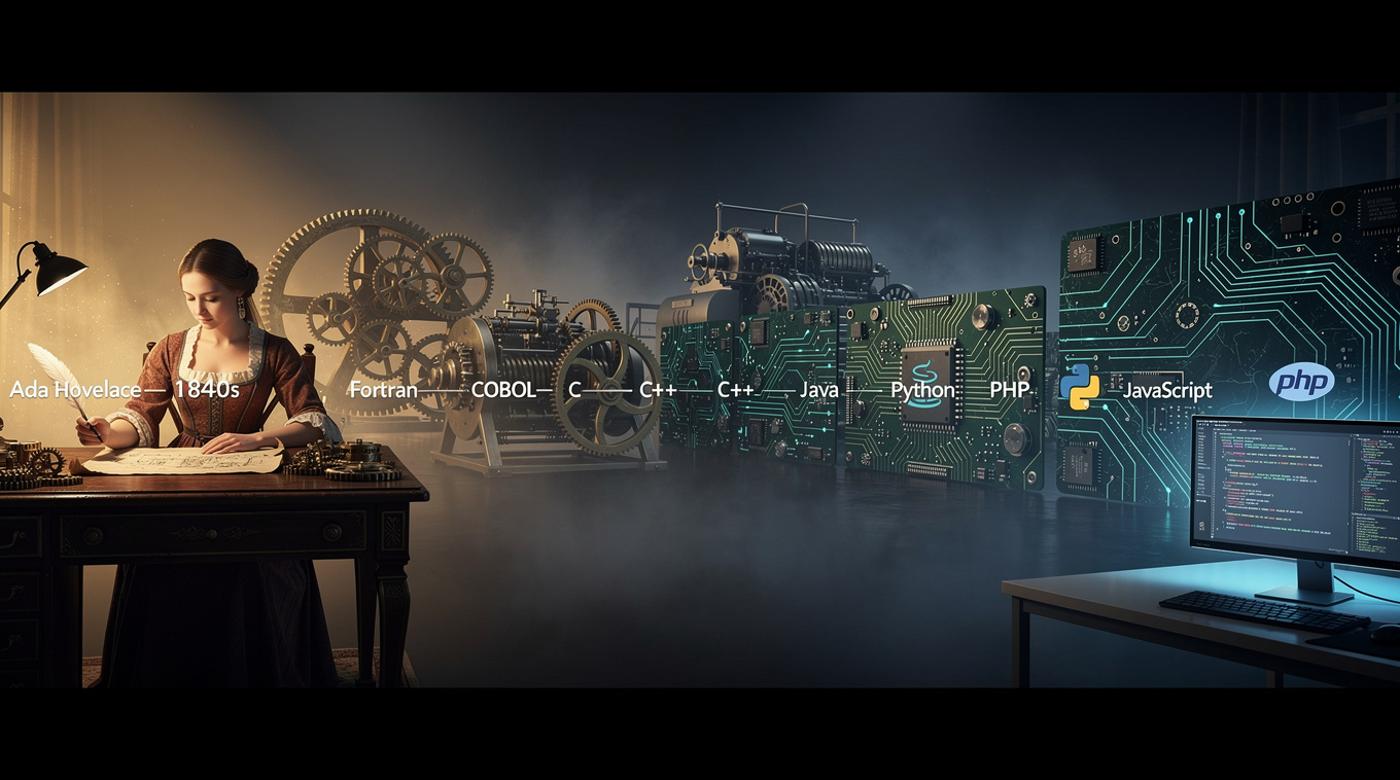
Overview
The history of coding is a remarkable journey from abstract mathematical concepts to the invisible infrastructure powering our digital world. It began not with computers, but with a visionary algorithm penned in 1843, and has evolved through layers of abstraction, from manipulating raw hardware with binary to writing human-readable instructions that are automatically transformed into machine code. This evolution reflects a constant tension between efficiency and accessibility, between the machine's needs and the programmer's mind. From the first high-level language conceived on paper to today's ecosystems of frameworks and no-code tools, each milestone expanded who could program and what could be built, ultimately democratizing creation and reshaping society.
The Dawn of Programming: Ada Lovelace's Vision
Coding predates the computer by a century. In 1843, Ada Lovelace, while translating Luigi Menabrea's notes on Charles Babbage's Analytical Engine, appended her own annotations that contained what is now considered the first published computer program. Her algorithm, designed to compute Bernoulli numbers, was a sequence of operations for the never-built mechanical computer. More profoundly, she envisioned that such a machine could manipulate symbols beyond mere calculation, potentially creating music or art. Her notes laid the theoretical blueprint for programming, establishing the core idea that machines could be instructed to perform tasks via a precise, logical sequence, the essence of code. This conceptual leap separated the hardware from the software long before either truly existed.
Konrad Zuse's Plankalkül: The First High-Level Language
In the 1940s, amid the turmoil of World War II, German engineer Konrad Zuse developed the Z1 computer and, alongside it, Plankalkül ("Plan Calculus"). Completed in 1945, Plankalkül is recognized as the first high-level programming language, though it remained unimplemented until the 1970s. Zuse designed it to express complex algorithms mathematically, with features like variables, loops, and conditional statements, abstracting away from machine-specific details. Written on paper, it included operations for floating-point arithmetic and data structures, aiming to bridge human logic and machine execution. Its syntax was visionary but cumbersome, using a two-dimensional notation. Plankalkül's existence demonstrated that programming could be a disciplined, language-based activity, even in computing's infancy.
Machine Code and Assembly: The Low-Level Foundations
The earliest electronic computers of the 1940s, like ENIAC, were programmed directly in machine code, binary sequences (e.g., 01010101) that corresponded to specific hardware instructions. This was tedious and error-prone, requiring deep knowledge of the machine's architecture. In 1949, Assembly language emerged as a revolutionary step, using mnemonics like ADD (for addition) or MOV (for move) to represent machine code instructions. An assembler would then translate these mnemonics into binary. While Assembly was more human-readable, it remained low-level, tightly coupled to the processor it was written for. Programmers in this era often "hand-tuned" code for maximum efficiency, as memory was severely limited. This period established the foundational layer where software directly manipulates hardware, a necessity that persists in systems programming today.
Short Code and Early Interpreters: 1949's Incremental Step
In 1949, John Mauchly proposed Short Code (originally called "Brief Code") for the UNIVAC I, representing one of the first attempts at a high-level language for electronic computers. It allowed mathematical expressions to be written in a more familiar form (e.g., X0 = (Y1 + Y2) / Y3), which were then manually or interpretively converted into machine code. The conversion was slow, as it involved a process of substitution and interpretation at runtime, but it significantly improved readability. Short Code marked a shift from purely binary programming toward abstraction, though it lacked the sophistication of later compiled languages. It hinted at the future where programmers could think in terms of problems rather than hardware constraints.
Autocode: 1952's Compiled Revolution
Alick Glennie developed Autocode for the Manchester Mark 1 computer in 1952, creating the first compiled programming language. A compiler is a program that translates high-level code into machine code all at once, producing an executable file. Autocode automated this translation, eliminating the manual effort required in Assembly or interpretive systems like Short Code. It included features for common mathematical operations and loops, making it easier to write routines for scientific calculations. Though primitive by modern standards, Autocode demonstrated the power of compilation to accelerate development and improve portability across different hardware variants. It set the stage for more efficient high-level languages.
FORTRAN: 1957's Scientific Powerhouse
IBM's John Backus and his team began developing FORTRAN (Formula Translation) in 1954, releasing it in 1957. It was the first widely used high-level programming language, designed specifically for scientific and engineering computations. Skeptics doubted that code written in FORTRAN could be as efficient as hand-coded Assembly, but Backus's team proved them wrong by creating an optimizing compiler that generated fast machine code. FORTRAN introduced key constructs like the DO loop for iteration, IF conditional statements, and GOTO for jumps, which became staples of programming. Its success was immediate, enabling complex simulations and calculations. Remarkably, FORTRAN remains in use today, particularly in high-performance computing for climate modeling and physics simulations, a testament to its robust design.
ALGOL 58: Structured Syntax Pioneer
In 1958, an international committee of computer scientists created ALGOL (Algorithmic Language), specifically ALGOL 58, as a language for describing algorithms precisely. It introduced block structure, where code could be organized into nested blocks with local variables, enhancing clarity and modularity. ALGOL's syntax influenced nearly every subsequent language, including C, Java, and Pascal. A key contribution was the Backus-Naur Form (BNF), developed by John Backus and Peter Naur, which provided a formal grammar for defining programming language syntax. BNF became the gold standard for language specification, ensuring unambiguous interpretation. Though ALGOL saw limited commercial use, its conceptual innovations made it the "mother of modern programming languages," emphasizing structured programming principles.
LISP: 1958's AI Legacy
Also in 1958, John McCarthy invented LISP (List Processor) for artificial intelligence research. It was based on lambda calculus and featured a unique syntax using parentheses for everything, which could be daunting but enabled powerful symbolic computation. LISP introduced recursion as a primary control structure, automatic memory management via garbage collection, and the ability to treat code as data (homoiconicity). These features made it ideal for AI applications, such as natural language processing and theorem proving. Dialects like Scheme and Common Lisp evolved, maintaining LISP's influence in academia and industry. Today, LISP's legacy endures in functional programming paradigms and machine learning frameworks, proving its visionary design.
COBOL: 1959's Business Behemoth
Grace Hopper, a pioneer in computing, played a key role in developing COBOL (Common Business-Oriented Language) in 1959. Designed for business data processing, COBOL used an English-like syntax with verbose statements (e.g., ADD SALARY TO TOTAL), making it accessible to non-programmers in fields like finance and administration. Its goal was portability across different manufacturers' machines, achieved through standardization. COBOL dominated enterprise computing for decades, running payroll, banking, and government systems. Critics often deride its wordiness, but its readability and reliability ensured its longevity. Even now, legacy COBOL systems underpin critical infrastructure, with ongoing efforts to modernize or maintain them.
BASIC: 1964's Democratization
In 1964, John Kemeny and Thomas Kurtz at Dartmouth College created BASIC (Beginner's All-purpose Symbolic Instruction Code) to make programming accessible to students without a strong math background. It featured simple statements like PRINT, INPUT, and GOTO, allowing beginners to write interactive programs quickly. BASIC's popularity exploded with the rise of personal computers in the 1970s and 1980s, as it was often included as a built-in language. Microsoft's first product, developed by Bill Gates and Paul Allen, was a BASIC interpreter for the Altair 8800. This helped ignite the PC revolution, empowering hobbyists and early developers. While criticized for promoting unstructured code with excessive GOTO statements, BASIC's role in democratizing programming is undeniable, bringing coding into homes and schools.
C: 1972's Systems Mastery
Dennis Ritchie at Bell Labs developed the C programming language in 1972, building on earlier languages like BCPL and B. C was designed for system programming, particularly for the Unix operating system, which Ritchie also co-created. It struck a balance between low-level control and high-level abstraction, offering features like pointers for direct memory manipulation, structures for data organization, and a rich set of operators. C's portability, achieved through compilers that could target different hardware, made it a universal language for operating systems, embedded systems, and applications. Its influence is profound: languages like C++, Java, and C# are directly descended from C. Even today, C remains essential for performance-critical software, from kernels to game engines.
Pascal: 1970's Teaching Tool
Niklaus Wirth introduced Pascal in 1970, naming it after the mathematician Blaise Pascal. It was designed to teach structured programming principles, emphasizing strong typing, clear syntax, and modularity through procedures and functions. Pascal's strict rules helped prevent common errors, making it ideal for education. It gained popularity in academia and was adopted by early Apple computers for development. Variants like Turbo Pascal, with its integrated development environment (IDE), brought Pascal to a wider audience in the 1980s. Though largely supplanted by languages like C and Java in industry, Pascal's legacy lives on in languages that prioritize safety and readability, such as Ada and Modula-2.
The Rise of Object-Oriented Paradigms
The 1970s saw the emergence of new programming paradigms that addressed growing software complexity. Smalltalk, developed at Xerox PARC in the 1970s, pioneered pure object-oriented programming (OOP), where everything is an object communicating via messages. It introduced concepts like classes, inheritance, and polymorphism, promoting code reuse and modularity. Concurrently, Prolog (1972) exemplified logic programming, where programs are expressed as facts and rules, and execution involves logical inference. These paradigms expanded the programmer's toolkit, moving beyond imperative sequences to models that better mirrored real-world entities or logical relationships. OOP, in particular, became dominant, influencing languages from C++ to Python, and shaping modern software design.
PHP: 1994's Web Scripting Surge
Rasmus Lerdorf created PHP (Personal Home Page) in 1994 as a set of Perl scripts to manage his personal website. It evolved into a server-side scripting language embedded within HTML, allowing dynamic web page generation. PHP scripts could interact with databases, handle form data, and create content on the fly, making it ideal for early web applications like blogs, forums, and content management systems. Its simplicity and tight integration with the Apache web server led to rapid adoption. By the late 1990s, PHP powered a significant portion of the web, including platforms like WordPress. Despite criticisms of inconsistent syntax and security issues in early versions, PHP's role in enabling the interactive web of the 2000s is monumental, and it remains a backbone of many legacy and modern sites.
JavaScript: 1995's Client-Side Magic
In 1995, Brendan Eich at Netscape developed JavaScript (originally called LiveScript) in just 10 days, aiming to add interactivity to web browsers. Unlike server-side languages, JavaScript runs on the client side, manipulating the Document Object Model (DOM) to update pages without reloading. This enabled features like form validation, animations, and dynamic content. Initially seen as a toy language, JavaScript gained seriousness with the advent of AJAX in the early 2000s, allowing asynchronous data fetching. Today, with Node.js, JavaScript runs on servers too, and frameworks like React and Angular support complex single-page applications (SPAs). JavaScript's ubiquity is staggering, it is the lingua franca of the web, essential for front-end and full-stack development.
CMS Era: WordPress and Beyond (2003-Present)
The Content Management System (CMS) era began in earnest with the release of WordPress in 2003, built on PHP and MySQL. WordPress democratized web publishing by allowing non-programmers to create and manage websites through a user-friendly interface, themes, and plugins. Alongside alternatives like Drupal (2000) and Joomla (2005), it shifted web development from hand-coding every page to configuring pre-built systems. This lowered the barrier to entry, enabling blogs, small businesses, and even large media sites to thrive. The trend continues with no-code and low-code platforms like Wix and Squarespace, which abstract away coding entirely. The CMS era represents a culmination of coding's evolution: from expert-only toolkits to accessible platforms that empower millions to build online presence without writing a line of code.
High-Level Abstractions Today: Python, JS Ecosystems
In the 2020s, programming is dominated by high-level abstractions that maximize productivity. Python, with its readable syntax and extensive libraries, reigns in data science, artificial intelligence, and web development (via Django). JavaScript, through Node.js and frameworks like React and Vue, enables full-stack development with a single language. Rust offers memory safety without sacrificing performance, appealing to systems programmers. Underpinning this are sophisticated compilers and interpreters that handle optimization and hardware abstraction seamlessly. The ecosystem includes package managers (e.g., npm, pip), cloud platforms, and DevOps tools, creating a layered environment where developers focus on logic rather than low-level details. This represents coding's current frontier: not just writing instructions, but orchestrating complex, distributed systems with ease.
Conclusion
The history of coding is a story of abstraction and accessibility, from Ada Lovelace's theoretical algorithm to today's no-code platforms. Each leap, from machine code to Assembly, from compiled languages to object-oriented paradigms, and from web scripting to CMS, has expanded who can program and what they can create. This evolution reflects a relentless drive to bridge human thought and machine execution, making technology more malleable and inclusive. As we look to the future, with AI-assisted coding and quantum programming on the horizon, the core principles remain: clarity, efficiency, and creativity. Coding has transformed from a niche technical skill into a fundamental literacy, shaping not just software, but society itself.