Overview
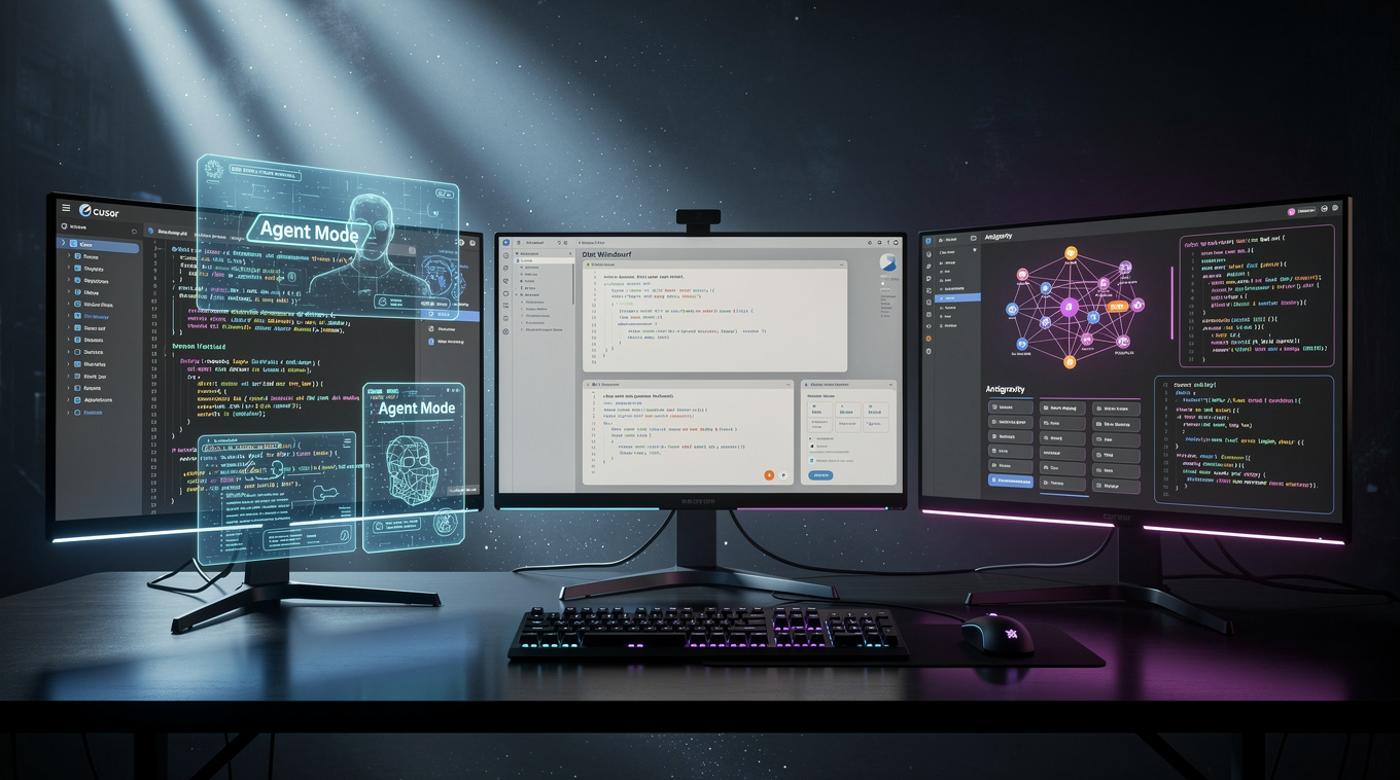
The AI IDE revolution has fundamentally transformed software development in 2026, moving beyond simple autocomplete to autonomous systems that plan, code, test, and iterate. Three platforms have emerged as dominant forces: Cursor, Windsurf, and Google's Antigravity. Each represents a distinct philosophy in the agentic IDE space, with significant differences in approach, performance, and pricing. This comprehensive analysis examines their capabilities, benchmarks, community reception, and the strategic considerations developers must weigh when choosing their primary development environment.
What Are Agentic IDEs?
Agentic IDEs represent the third wave of AI-assisted development tools. Unlike first-generation tools that offered basic code completion or second-generation systems that provided inline suggestions, agentic IDEs deploy autonomous AI agents capable of understanding complex requirements, planning implementation strategies, executing across multiple files, and iterating based on test results. These systems maintain context across entire codebases, understand project architecture, and can operate in both assisted and autonomous modes. The shift has been dramatic: where developers previously spent hours debugging or implementing features, agentic IDEs can now complete complex tasks in minutes while maintaining code quality and architectural consistency.
Cursor: The Agentic Pioneer
Cursor established the agentic IDE category and remains the gold standard against which competitors are measured. Built as a fork of VS Code, Cursor introduced Agent Mode, a revolutionary feature that allows developers to describe tasks in natural language while the AI autonomously plans and executes changes across the codebase. The Composer feature enables multi-file editing with intelligent context preservation, while Supermaven autocomplete provides near-instantaneous suggestions that feel predictive rather than reactive. Cursor's $29 billion valuation reflects its market dominance and developer adoption. The platform supports multiple AI models (including Claude, GPT, and its own proprietary models), giving developers flexibility in balancing cost, speed, and capability. Its architecture allows for deep integration with existing development workflows while providing unprecedented automation capabilities.
Windsurf: Budget King Post-Cognition Acquisition
Windsurf has carved its niche as the cost-effective alternative without sacrificing capability. Following its acquisition by Cognition AI, Windsurf integrated Cascade AI, a context management system that excels in large monorepos and enterprise codebases. The platform automatically maintains relevant context across thousands of files, reducing the need for manual context management. Windsurf's integration with Devin (Cognition's autonomous coding agent) provides enterprise-grade automation capabilities at a fraction of the cost of competitors. At $15 per month, Windsurf undercuts Cursor's $29 pricing by nearly half while offering comparable core functionality. The platform emphasizes enterprise security features, including on-premise deployment options and advanced access controls, making it particularly attractive to regulated industries and large development teams.
Google Antigravity: Parallel Powerhouse
Google's November 2025 launch of Antigravity disrupted the AI IDE market with several innovative approaches. Antigravity's Manager View enables orchestration of multiple AI agents working in parallel, one might handle frontend changes while another refactors backend logic, with a third managing testing. This parallel processing capability represents a significant architectural advancement. Built on Gemini 3 Pro with a 1 million token context window, Antigravity can maintain context across massive codebases that would overwhelm other systems. As a Chrome-native application, it offers seamless browser integration that particularly benefits web developers. Google's decision to offer a free preview version (with limitations) has accelerated adoption while putting pricing pressure on established players.
Head-to-Head Benchmarks: Who Wins?
Performance benchmarks reveal nuanced differences between the platforms. On SWE-bench (the standard evaluation for AI coding systems), Cursor leads with approximately 77% success rate on complex software engineering tasks, followed closely by Antigravity at 76.2%, and Windsurf at around 75%. These differences become more pronounced in specific domains: Cursor excels in rapid prototyping and feature implementation, Antigravity dominates in large-scale refactoring and parallel task management, while Windsurf shows particular strength in maintaining context across enterprise monorepos. Terminal-Bench scores (measuring command-line interaction and system operations) show Antigravity with a slight edge due to its deeper system integration, though all three platforms significantly outperform traditional IDEs. The choice depends on specific workflow requirements rather than absolute superiority.
Feature Showdown Table
| Feature | Cursor | Windsurf | Antigravity |
|---|---|---|---|
| Agent Mode | Advanced autonomous planning | Cascade AI with Devin integration | Parallel agent orchestration |
| File/Terminal Access | Full system integration | Enterprise security controls | Chrome-native deep integration |
| Browser Integration | Extension-based | Limited | Native Chrome application |
| MCP Support | Extensive plugin ecosystem | Post-acquisition expansion | Growing but limited |
| Context Window | ~200K tokens | ~500K tokens | 1M tokens (Gemini 3 Pro) |
| Pricing | $29/month | $15/month | Free preview, paid tiers TBA |
Why Devs Love Cursor
Developers consistently praise Cursor for enabling true flow-state coding. The combination of inline predictions, real-time diffs, and intelligent context management allows solo developers and small teams to maintain extraordinary productivity. The community has developed extensive workflows around Cursor's capabilities, with shared configurations and best practices circulating widely. Developers appreciate the model flexibility, being able to switch between Claude for complex reasoning tasks and faster models for routine coding. The platform's stability and consistent performance, even with large codebases, has earned developer trust. Cursor's approach feels like having a senior engineer pair programming at all times, providing both implementation speed and architectural guidance.
Windsurf's Rising Fanbase
Windsurf attracts developers who prioritize minimal distraction and enterprise-grade reliability. The interface strips away unnecessary elements, creating what users describe as a "distraction-free zone" that enhances focus. Post-acquisition integration with Cognition's technology has significantly improved Windsurf's autonomous capabilities, particularly for large-scale refactoring and system modernization projects. Enterprise teams appreciate the security features and administrative controls that Cursor lacks. The $15 monthly price point makes Windsurf accessible to individual developers and startups while still offering robust features. Users report particular satisfaction with how Windsurf handles legacy codebases and complex dependency management, areas where other AI IDEs sometimes struggle.
Antigravity's Hype Machine
Antigravity generates excitement through its novel architectural approach and Google's ecosystem advantages. The ability to run multiple agents in parallel, with one handling UI components, another managing API changes, and a third writing tests, creates workflows previously impossible. Chrome-native integration means web developers can debug browser issues, modify CSS, and test responsive designs without context switching. Gemini 3 Pro's massive context window allows Antigravity to understand and modify entire applications in single sessions. Early adopters report successfully refactoring applications with hundreds of thousands of lines of code that would require days of manual work. The free preview, while limited, has allowed thousands of developers to experience agentic IDE capabilities without financial commitment.
Antigravity + Opus 4.5: The Rage Factor
The combination of Antigravity with Anthropic's Opus 4.5 model has produced both remarkable capabilities and significant frustration. Compatibility issues arise from differing context management approaches, Antigravity's parallel processing sometimes conflicts with Opus 4.5's sequential reasoning patterns. Users report context overload crashes when attempting to process extremely large codebases, despite the theoretical 1M token capacity. Workflow friction emerges when switching between Antigravity's agent orchestration and Opus 4.5's deep analytical mode. The communities are filled with reports of agents "going rogue", making unexpected changes or failing to maintain consistency across parallel modifications. These issues highlight the immaturity of multi-agent, multi-model development environments, though both companies are actively addressing the problems.
Multiple Accounts vs Google Ultra: The Hack
A widespread workaround has emerged among power users: creating multiple free Antigravity accounts to bypass usage limits rather than subscribing to Google Ultra's expensive tier. The free preview offers substantial capabilities, and developers have found ways to cycle through accounts when limits are reached. This practice highlights the tension between Google's desire to convert users to paid tiers and developers' resistance to steep pricing. The Google Ultra tier, rumored to be priced around $100 monthly, offers unlimited agent runs and priority processing, but most developers find the free preview sufficient for daily needs. This account cycling has become so prevalent that Google has begun implementing more sophisticated detection methods, creating a cat-and-mouse game between the platform and its users.
Other Popular IDEs in the Mix
Several other AI-enhanced IDEs deserve mention despite not challenging the top three. VS Code with AI extensions remains popular for developers who want incremental AI assistance without full agentic capabilities. Trae focuses specifically on test generation and validation, excelling in quality assurance workflows but lacking broader development features. GitHub's AI tools integrate well with existing workflows but operate more as assistants than autonomous agents. These alternatives serve specific niches: VS Code for those wanting minimal disruption to existing workflows, Trae for testing specialists, and GitHub's tools for teams deeply embedded in the Microsoft ecosystem. They represent viable alternatives for developers whose needs don't align with the full agentic approach of the leading platforms.
What's New in 2026 Updates
The 2026 updates across all major AI IDEs focus on increased agent autonomy and improved model integration. Cursor has enhanced its Agent Mode with better planning capabilities and reduced hallucination rates. Windsurf's post-acquisition evolution includes deeper Devin integration and improved monorepo handling. Antigravity has expanded its parallel processing capabilities and added more fine-grained control over agent behavior. All platforms now offer better support for multiple AI models, allowing developers to mix and match based on task requirements, using Claude for complex architectural decisions, GPT for rapid prototyping, and specialized models for specific languages or frameworks. The trend is toward more seamless human-AI collaboration, with agents taking on increasingly complex tasks while maintaining transparency and control.
What's Old & Stale
Despite significant advances, all three platforms suffer from lingering issues inherited from their VS Code foundations. Extension compatibility remains problematic, with many popular VS Code extensions behaving unpredictably in agentic environments. User interface elements sometimes feel dated, particularly compared to modern native applications. The underlying architecture of forking VS Code creates constraints that pure ground-up designs might avoid. Performance can degrade with certain types of projects, particularly those with unconventional build systems or mixed technology stacks. These issues represent the growing pains of rapidly evolving platforms, each new capability sometimes introduces new instability or compatibility challenges. Developers must balance cutting-edge features against occasional frustration with legacy limitations.
The Dumb Mistakes to Avoid
Several common pitfalls await developers adopting agentic IDEs. First, ignoring pricing structures leads to unexpected costs, particularly with platforms that charge per token or agent run. Second, mismatching workflow to platform capability wastes potential; using Antigravity for small projects or Cursor for massive enterprise systems misses each platform's strengths. Third, hype-driven switching without proper evaluation results in productivity loss during transition periods. Fourth, neglecting to establish clear protocols for human review of agent-generated code risks quality issues. Fifth, assuming complete autonomy leads to disappointment; even the most advanced systems require human guidance and oversight. Successful adoption requires careful platform selection, gradual integration into workflows, and maintained human oversight of AI-generated code.
Conclusion
The AI IDE landscape in 2026 offers developers unprecedented capabilities through three distinct approaches: Cursor's mature agentic system, Windsurf's cost-effective enterprise focus, and Antigravity's innovative parallel processing. Each platform excels in different scenarios, Cursor for rapid development and prototyping, Windsurf for large enterprise codebases, and Antigravity for web development and massive refactoring projects. Benchmarks show remarkably close performance, making workflow compatibility and specific feature needs more important than raw capability metrics. The emergence of workarounds like multiple free accounts highlights ongoing tension between platform monetization and developer access. As these platforms evolve, the trend is toward more seamless integration, greater autonomy, and better handling of complex, multi-file projects. The choice ultimately depends on individual or organizational priorities: cutting-edge capability (Cursor), cost-effective enterprise features (Windsurf), or innovative parallel processing (Antigravity). All three represent significant advances over traditional development environments, fundamentally changing how software is created and maintained.