Overview
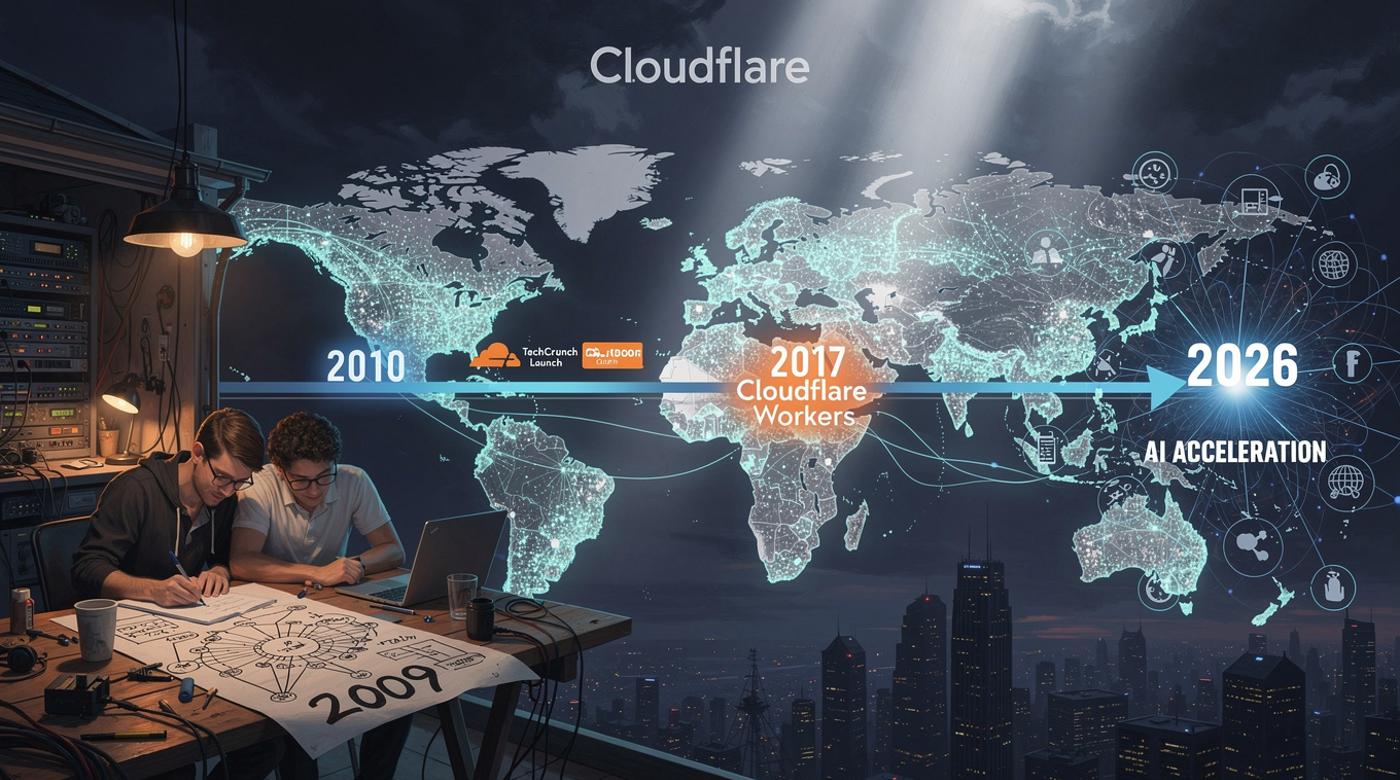
Cloudflare emerged from the shadows of early internet threats, transforming a simple anti-spam project into a colossus that shields one-fifth of global web traffic. Founded amid rising DDoS attacks and sluggish sites, the company promised, and delivered, a proxy layer blending security with blistering performance. By 2026, its network spans 330+ cities, powering everything from Zero Trust gateways to AI inference at the edge. matrixbcg.com
What began as a Harvard dorm-room brainstorm now influences how developers build, secure, and scale applications worldwide. Readers will trace the arc: humble origins in Project Honey Pot, explosive freemium growth post-2010 launch, seismic pivots like Workers and R2, and a public market valuation soaring past $30 billion. This isn't mere chronology, it's the blueprint of how edge computing redefined cloud wars.
Cloudflare's ascent reveals broader truths about tech evolution. Free tiers hooked millions; acquisitions fortified defenses; serverless unlocked developer dreams. Yet challenges loomed, lawsuits, competition from Akamai, outages that tested resilience. Through it all, founders Matthew Prince, Lee Holloway, and Michelle Zatlyn steered toward a 'secure, fast, reliable' internet mantra, now etched in every PoP worldwide.
By dissecting funding rounds, product drops, and strategic bets, this guide equips developers, founders, and analysts to grasp Cloudflare's playbook. Expect timelines unpacked, milestones tabled, and forward glances at AI dominance. How did a spam-tracker become the internet's bodyguard? Let's chart the path. portersfiveforce.com
The Pre-Cloudflare Roots: Project Honey Pot (2004-2008)
Long before Cloudflare's logo lit up screens, its DNA formed in the trenches of email abuse. In 2004, Matthew Prince and Lee Holloway launched Project Honey Pot under Unspam Technologies. This distributed trap snared spammer bots, mapping their IP origins to expose bad actors, a novel twist on honeypots.
Why did this matter? Early 2000s webmasters drowned in spam; sites crawled with harvesters scraping emails. Honey Pot flipped the script, aggregating threat intel across volunteers. By 2008, it boasted millions of data points, revealing patterns in bot behavior and DDoS precursors. Prince, then at Harvard Business School, saw gold: weaponize this data for real-time web defense.
Holloway's engineering wizardry built the backbone. A low-profile sysadmin phenom, he coded prototypes in spare time, reputation scoring for IPs, basic caching to thwart scrapers. Enter Michelle Zatlyn, Prince's classmate, blending operations savvy with product vision. Their trio gelled over shared frustration: websites too vulnerable, too slow.
This era honed Cloudflare's ethos, data-driven, distributed, developer-friendly. No central servers; edge everywhere. Honey Pot proved global collaboration could outpace lone-wolf attackers. By 2009, they pitched: a cloud proxy proxying traffic through scrubbed nodes, accelerating delivery while nuking threats.
Official Founding: July 26, 2009
Cloudflare materialized on July 26, 2009, in Palo Alto, California, silicon heartbeat pulsing nearby. Prince (CEO), Holloway (CTO), Zatlyn (CCO) incorporated, channeling Honey Pot's intel into a full-stack service. Initial HQ buzzed with ambition: free DDoS protection, CDN smarts, all via DNS flip.
Pivotal validation hit in April 2009: they clinched Harvard Business School's business plan contest. Judges lauded the freemium model, free for small sites, paid tiers for enterprises. Momentum snowballed. November brought $2.1 million Series A from Pelion Venture Partners and Venrock. Funds fueled Holloway's prototype: a reverse proxy blending caching, WAF, and mitigation.
Headquarters shifted to San Francisco soon after, eyeing talent pools. Early hires trickled in, engineers tweaking Anycast routing for sub-50ms latencies. Core pitch sharpened: 'Make the Internet better.' No mere accelerator; a force multiplier against Akamai's CDN monopoly and emerging botnets.
Challenges surfaced fast. Bootstrapping meant lean ops; Holloway coded nights away. Yet traction brewed. By mid-2010, beta users raved: 30% speedups, zero-downtime under attacks. The stage set for TechCrunch glory.
Explosive Public Launch: TechCrunch Disrupt 2010
September 27, 2010, TechCrunch Disrupt. Cloudflare demoed live, proxying traffic through nascent PoPs. Judges, crowd, erupted: free security? Global CDN? Signups spiked overnight. Freemium nailed it, thousands onboarded via one-DNS-change setup.
First data center? Chicago, early 2010, testing waters. Post-launch, PoPs mushroomed: North America, Europe, Asia. By 2011, 100 billion page views monthly. Why the frenzy? Sites like Etsy, Lenovo joined early; performance leaped 30%, DDoS blocks seamless. timeline.www.cloudflare.com
Growth hacked via virality. Free plan included analytics dashboards, hooking devs. Paid upgrades targeted SMBs battered by LOIC attacks, infamous 2010-2011 botnet waves. Cloudflare absorbed them effortlessly, burnishing hero status.
Internally, culture crystallized. Weekly 'all-hands' birthed traditions; birthday weeks teased products. Holloway's edge network scaled horizontally, colos leased cheaply, software-defined routing crushed latency.
| Year | Milestone | Impact |
|---|---|---|
| 2010 | TechCrunch Launch | 1,000+ sites day one; freemium proves viral |
| 2011 | 100B page views | Validates global scale |
This phase cemented Cloudflare as disruptor. No hardware fleets; pure software edge. Investors circled.
Funding Surge and Global Expansion (2011-2013)
July 2011: $20 million Series B. Network exploded, dozens of PoPs, cache hits soared. 2012 brought $50 million Series C, fueling EU/APAC builds. Millions of domains routed through; free users subsidized enterprise wins like VMware.
Strategy? Land-grab PoPs in Tier-1 colos. Anycast BGP announced routes dynamically; traffic steered to nearest node. Latency plummeted; uptime hit 99.99%. SMBs flocked, publishers dodging scrapers, e-com shielding carts.
Acquisitions hinted maturity. 2014 foreshadowed, but 2012 focused infrastructure. Team swelled past 100; Zatlyn championed ops automation. Prince evangelized: 'Web needs guardians.' By 2013, 5% of Fortune 1000 proxied.
Numbers dazzled. 1 trillion pages/year. Yet underbelly: scaling pains. Rare outages spotlighted single-PoP reliance, lessons hardened redundancy.
Product Pivots: Security and Performance Leap (2014-2016)
2014 redefined accessibility. Universal SSL launched, free HTTPS for all. Overnight, millions encrypted; Chrome's padlock stigma faded. Acquired StopTheHacker (vuln scanning), CryptoSeal (TLS tech). Project Galileo debuted: pro bono for activists, journalists under attack.
Impact? HTTPS adoption rocketed from 30% to 60% web-wide. Cloudflare shouldered cert issuance, renewals, seamless. DDoS pipe swelled to 100Tbps scrubbed.
2015 layered DNS, Web Security, Performance suites. Rate limiting, schema validation curbed bots. 2016: more acquisitions, Scan.io (vuln mgmt). Network hit 100 cities.
Developers praised Polish. Free tier evolved: image optimization, rocket loader JS. Enterprises bought in: custom rules, dedicated IPs. Revenue ticked up, $100M ARR whispers.
| Acquisition | Year | Tech Added |
|---|---|---|
| StopTheHacker | 2014 | Vuln scanning |
| CryptoSeal | 2014 | TLS hardening |
| Scan.io | 2016 | Automated pentests |
Era of consolidation. Cloudflare wasn't just proxy, ecosystem builder.
Universal SSL's Ripple Effects
Free certs solved 'HTTPS tax.' Small blogs, NGOs gained parity. Google rankings boosted adopters. Backend? Automated Let's Encrypt precursors, edge-terminated TLS offloaded origin servers.
Critics? CA monopoly fears, mitigated by open standards. Legacy win: paved QUIC/HTTP3 paths.
Developer Platform Dawn: Workers and Beyond (2017-2018)
2017: Cloudflare Workers. Serverless at edge, V8 isolates, ms cold starts. No AWS Lambda lock-in; run JS/Wasm globally. Devs scripted routing, A/B tests, API gateways sans infra.
Why revolutionary? Edge compute democratized. Traditional clouds centralized; Workers pushed logic to users. Adoption exploded: Stripe, Shopify integrated. KV store followed for state.
2018: 1.1.1.1 DNS resolver. Privacy-first, 4ms medians. WARP client encrypted mobile traffic. Network: 200 cities. Birthday tradition peaked, announce salvos.
Funding? $110M Series D (2018), valuing $1B+ unicorn. Magic Transit teased network-layer DDoS.
Code example, basic Worker:
addEventListener('fetch', event => {
 event.respondWith(handleRequest(event.request))
})

async function handleRequest(request) {
 return new Response('Hello, edge!', { status: 200 })
}
Deployed instantly, scales infinitely. Paradigm shift.
IPO and Enterprise Push (2019-2020)
September 13, 2019: NYSE debut (NET) at $15/share. Raised $500M+, $4-5B valuation. S-1 revealed $287M revenue, 20% web traffic. Prince: 'Build for decades.'
Post-IPO: Magic Transit (BGP scrubbing), enterprise DDoS at 100Tbps+. 2020: Cloudflare One, Zero Trust SASE. Remote work boom; Gateway, Access, Browser Isolation bundled.
Pandemic tested mettle. Traffic quadrupled; no major outages. R2 announced 2021, egress-free storage rivaling S3.
| Funding Round | Year | Amount | Valuation |
|---|---|---|---|
| Series A | 2009 | $2.1M | |
| Series B | 2011 | $20M | |
| Series C | 2012 | $50M | |
| IPO | 2019 | $500M | $4-5B |
Public scrutiny sharpened focus. Compliance: SOC2, GDPR. Headcount: 1,000+.
Zero Trust and Storage Wars (2021-2023)
2021: R2 object storage, zero egress fees. S3-compatible, edge-integrated. Devs ditched vendor lock; costs plummeted 70% for hot data.
Cloudflare One matured: Magic WAN SD-WAN, Teams IDP. SASE market share climbed vs. Zscaler, Palo Alto. 2022: 285 cities, 330Tbps scrub.
Workers for Platforms: KV, D1 (SQL), Queues, Pub/Sub. Full backend stack edge-side. Hyperdrive cached DB queries.
2023: AI teases. Vectorize for embeddings. Stock doubled; ARR $1B+. Acquisitions: Area 1 (email security).
Challenges: 2022 Fastly outage spotlighted edge reliance, Cloudflare shone unscathed. Lawsuits (NSPE on 1.1.1.1 privacy) dismissed.
AI Era and 2024-2026 Ascendancy
2024: Workers AI, GPU inference edge-wide. Run LLMs latency-free; R2 stored vectors. Network: 300+ cities, 100+ countries.
By 2025, AI Runways: fine-tune models globally. Browser Rendering APIs for headless Chrome edge-side. Devs built agents, no infra.
2026 status (as of Feb): 20% internet traffic. ARR $2B+, market cap $35B. New: Durable Objects v2 for stateful apps. PoPs: 350+. One platform unified CDN/WAF/ZeroTrust/AI/Storage.
| Recent Milestones | Year | Details |
|---|---|---|
| Workers AI | 2024 | Edge GPU inference |
| R2 Expansion | 2024 | AI-optimized storage |
| 330+ Cities | 2026 | Global anycast |
Competition heats: AWS Edge, Fastly Next-Gen. Cloudflare leads open ecosystems, WASM, KV OSS vibes.
Workers AI Deep Dive
Workers AI inference: Llama3, Whisper on 100+ model hub. Pay-per-second, edge-deployed. Example:
// AI text gen Worker
export default {
 async fetch(request, env) {
 const response = await env.AI.run('@cf/meta/llama-3-8b-instruct', {
 prompt: 'Explain edge AI'
 });
 return new Response(JSON.stringify(response));
 }
};
Latency: 200ms global. Revolution for chatbots, RAG.
Acquisitions and Ecosystem Builds
Strategic buys accelerated. Beyond 2014: Vega (EU cloud, 2020), Zaraz (tag mgmt, 2021). 2023+: Lacework stake (cloud sec). Total 20+.
| Category | Count | Examples |
|---|---|---|
| Security | 8 | Area1, StopTheHacker |
| Compute | 5 | Vega, BastionZero |
| Storage | 3 | R2 integrations |
Bolstered moats. Open sourced Pingora (Rust proxy), cementing cred.
Culture and Controversies
Birthday Weeks: annual product barrages. 2023: 15th, Tunnels, Argo Tunnel evo. All-remote post-COVID.
Flaks: 2019 Cato speech (Prince on deplatforming), 2021 Kiwi Farms row, upheld free speech. Balanced: Galileo protected 500+ orgs.
Diversity push; Zatlyn's CCO role pioneered. 2,500 employees by 2026.
Financial Trajectory
| Year | Revenue (M) | ARR (B) | Employees |
|---|---|---|---|
| 2019 | $287 | - | 700 |
| 2021 | $656 | $0.5 | 1,200 |
| 2023 | $1,300 | $1.3 | 2,000 |
| 2026 | - | $2+ | 2,500 |
GAAP profitable 2024. Rule of 40s nailed: 30% growth, 20% margins.
Prose unpacking: Revenue mix shifted, 60% enterprise, 25% Workers/Zero Trust, 15% consumer (1.1.1.1). Gross margins 75%+ via software leverage.
Competitors and Market Position
Akamai (CDN vet), AWS CloudFront (cheap scale), Fastly (dev-first). Cloudflare wins integration: one dashboard, pricing transparency.
| Competitor | Strength | Cloudflare Edge |
|---|---|---|
| Akamai | Media | AI/Zero Trust bundle |
| Fastly | Compute | Network scale (330 cities) |
| AWS | Ecosystem | Egress-free R2 |
20% traffic share cements pole position.
Future Outlook
2026-2030: AI ubiquity. Full-stack edge cloud, D1 global SQL, Pages Functions. Quantum-resistant crypto. 500 cities? Metaverse-ready PoPs.
Challenges: regulation (EU DMA), capex for GPUs. Strengths: $5B cash war chest, cult dev following.
Conclusion
Cloudflare's saga, from Honey Pot traps to Workers AI infernos, chronicles edge triumph over centralization. Key takeaways: freemium scales armies; acquisitions fill gaps; dev platforms lock loyalty. Founders' vision endures: faster, safer web for all.
Next steps? Deploy a Worker today, test the edge. Track NET earnings for AI ARR. For devs: migrate to R2, explore Vectorize. Analysts: watch SASE wars. Cloudflare doesn't just proxy traffic; it proxies the internet's future.